Besties in Biblical Times
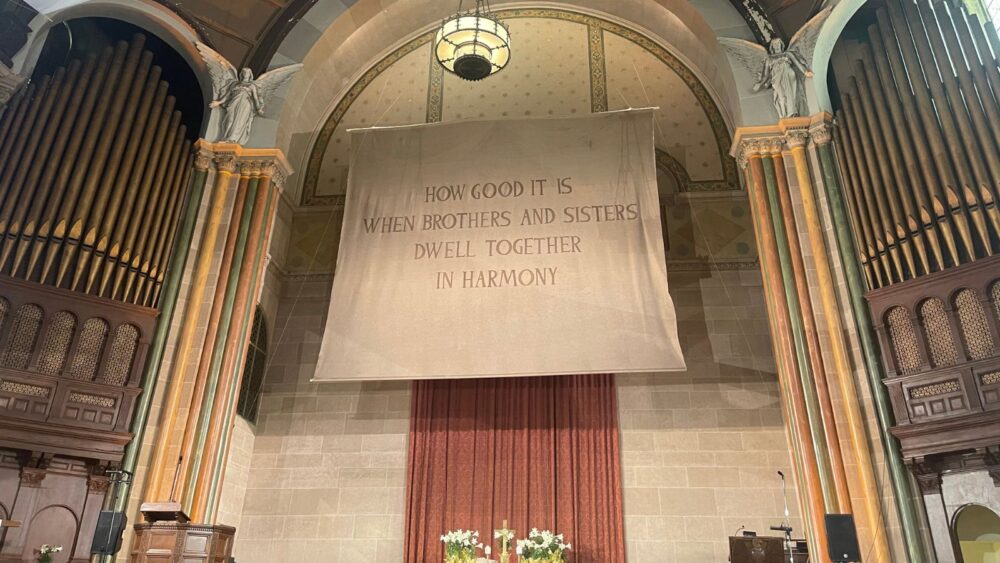
NEW YORK – Between two Christian spirituals, a rowdy group of seven kids run onto the stage during Sunday morning service at St. Paul & St. Andrew United Methodist Church on 86 Street on the Upper West Side.
A boy with a shaved head in a pink button-down takes the microphone and tells the congregation that he is going to his friend Jonah’s birthday party later that day. A coy girl in gingham with a long ponytail says her best friend Sophia always gives her presents. The congregation giggles.
However, the children’s chatty irreverence is not an interruption to the service. It’s time for the "Messages for All Ages" portion, during which the congregation’s youth and campus pastor, Ekama Eni, leads the children in a lesson before they head to the chapel for Sunday school. She teaches by example.
“I want to tell you about someone,” Eni says, leading off the message from the stage. She shows the children a photo of her friend Sam. “We cook together, we study together, we go to drag shows together. Would anyone like to tell me about their best friend?” What follows keeps the adults engaged, while the kids appreciate Eni saving them from the boredom of sitting quietly in a pew.
Eni tells the children that the Gospel reading they will hear while walking to Sunday school is about a man who is not feeling well and his four “besties.” The "besties" have heard that Jesus makes people better so they are going to take their friend to see him.
Theatrically retelling the story of Mark, chapter 2, when Jesus heals a paralyzed man, Eni says that the house where Jesus was at the time was very crowded, so the friends climbed onto the roof, cut a hole in the ceiling, and lowered their best friend into the house to see Jesus.
“That is dedication to being a bestie,” says Eni.
She emphasizes the importance of friends, those they can giggle with and do incredible things with, because Jesus loves them.
Eni, 30, graduated from Union Theological Seminary in 2021. She says that her approach to teaching kids is to invite mutual curiosity.
“I'm obsessed with the minds and thoughts of children,” she says after the service. “I'm always going to try and engage them most importantly as fellow human beings with thoughts and feelings.”
For Eni, it’s about making children feel like a part of the larger church community.
“Dear God, thank you for besties,” Eni says as she notices the children starting to get antsy. “Amen.” And the children scramble off to the chapel.
Teaching the Zoroastrian Youth: The Navjote Ceremony
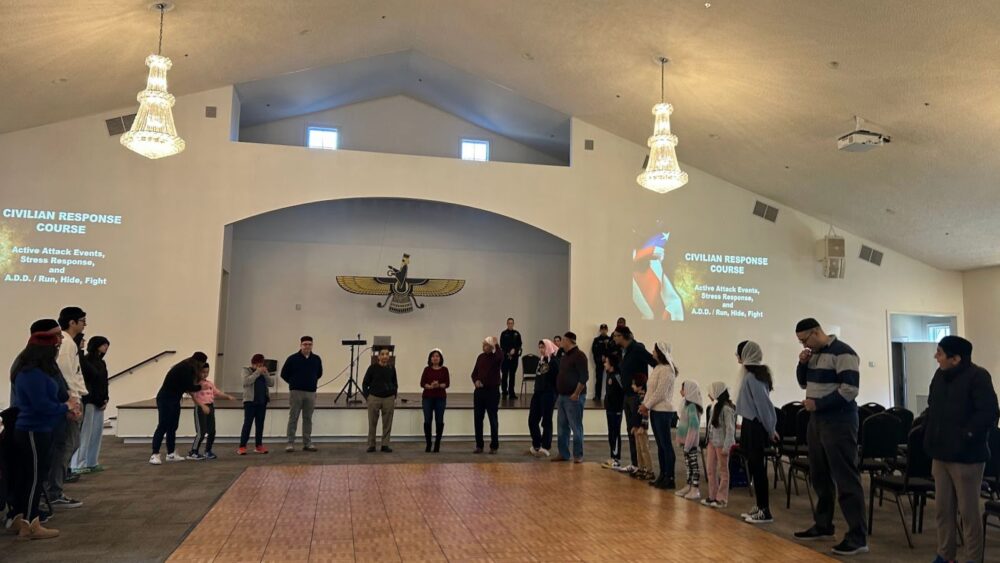
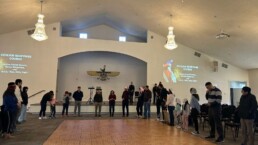
SUFFERN, N.Y. — Just before noon on a recent Sunday, about 50 Zoroastrian men and women stood in a circle clasping hands inside of the Dar-E-Mehr fire temple in this village about a 40-minute drive north of Manhattan. It is here, at 106 Pomona Rd., where Zoroastrians in the tri-state area meet monthly to pray and educate their youth.
Each person in the circle covered their head with either a shawl or a short cylindrical cap, called a topee. Some worshippers, including Khursheed Navdar, the prayer leader and the president of the Zoroastrian Association of Greater New York, shut their eyes, meditating while reciting the prayers. Others, including the many children, curiously peered at their fellow circle mates.
After Navdar finished the prayers, she opened the circle up for announcements. A mother introduced her kindergartener who was starting the religion education course, and a high school senior announced his cancer research fundraiser. Navdar instructed the adults to stay in the main auditorium for emergency response training while the children happily clambered up the stairs to their respective classrooms.
Inside one of the classrooms, Avan Patel, the daughter of a Zoroastrian priest, was preparing selections from children’s books on the faith. Patel’s lesson plan for the day was to introduce the Navjote — the religious induction ceremony for girls and boys between the ages of 7 and 15. It is also when a child receives a white cotton shirt (Sudreh) and woolen cord (Kusti), the ceremonial clothing that Zoroastrians wear every day as a kind of armor against evil. Patel settled on a book that describes the Navjote from the perspective of a young boy named Dinyar, which she said makes the ceremony more relatable for the children who may not have had their Navjote yet.
Patel, 47, fell in love with her religion courses as a child, leading her to start teaching her own Zoroastrian prayer and culture courses in 1998.
“As an adult, you realize the value of these Zoroastrian traditions, stories and prayers, and how they help you understand your identity in an overwhelming world,” Patel said. “Teaching the Zoroastrian children the ways of our religion makes me feel proud and happy as if I was a representative of our ancestors.”
Patel stood at the front of the room alongside her former student, Aaria Nadar, 17, who was now her teaching assistant. The four wide-eyed 7-year-olds in their class looked up intently as Nadar wrote “Navjote = new birth” on the whiteboard. To provide a mental image of the ceremony for the young ones, Nadar took out an iPad and began swiping through photos of her and her sister’s shared Navjote ceremony a few years ago in India.
“There’ll be older children who’ll guide and explain concepts to younger kids,” Patel said after the class, “and that always makes me smile, knowing that they’re learning and wanting to spread their knowledge with others.”
Patel explained how the ceremony lasts about 45 minutes and ends with the priest, or Dasturji, performing a blessing by showering the child with rose petals and rice. Afterwards, the child is dressed in new clothing and jewelry for a celebration. Oftentimes, the celebration includes a special dinner, called a Parsi Bonu, in which friends and family eat off banana leaves.
Patel then called for a volunteer. There were two girls and two boys in the class and both the girls raised their hands. Patel chose one, telling her, “Let’s pretend it’s your Navjote.” Nadar helped the girl put on the Sudreh. Patel pointed out the small pocket on the shirt’s front — “the pocket of good deeds,” representing the third and final aspect of the religion’s three-pronged motto: “good thoughts, good words, good deeds.” Patel and Nadar guided the girl to hold the Kusti, the sacred wool string, correctly: folded once and held taut horizontally across the body with one thumb holding the loop. The little girl helpfully reminded them to not let the Kusti touch the ground.
“Let the Sudreh and Kusti be the badge of service to Ahura Mazda [God],” Patel said. “These things that we wear on our body protect us, and it’s something to feel honorable about.”
Patel pointed to a photo of a bearded man and asked the children who it was: Ahura Mazda (the God) or Zarathustra (the prophet). Silence. “Ahura Mazda?” a young girl questioned. It was Zarathustra.
“Is God a human being?” Patel asked the children. “No,” Patel continued. “He’s a special force. We can’t see him, but he’s everywhere. And his name, just like we all have names, is Ahura Mazda. Zarathustra is a man on earth, just like us, and the son of God.”
To end the class, Patel pointed again to the photo of the bearded man and asked, “If you think it’s Zarathustra, raise your hand.” This time, the hands of all four children shot up in unison. Patel smiled.
“We all learn by either repetition or experience,” Patel said. “When I present a lesson to the kids by telling a story, writing notes on the whiteboard or doing arts and crafts relating to the lesson — it brings it to life.”
The Tealight Candle: A Zoroastrian Priest Prays at Home
NORTH BRUNSWICK, N.J. — Every day, Arshis Pavri lights a small tealight candle in his home in this New Jersey town an hour’s drive from Manhattan. The flame is magnified in the reflection on its container, a small glass etched with the profile of a bearded man — the Zoroastrian prophet Zarathustra. The prophet, head covered with a topi, or hat, and hands joined in prayer, is balanced atop phoenix-like wings. There are three layers of wings, one layer for each of Zoroastrianism’s three values: Humata Hukhta Hvarshta, or “good thoughts, good words, good deeds.”
Pavri wears a thin white cotton shirt, called a Sudreh, with a quarter-sized square pocket sewn in at the dip of the V-neck. The pocket holds good deeds, he says. He wraps a long wool shoelace-like wool cord, called a Kusti, three times around himself, just below his navel — one knot in the front and one in the back. Before beginning his favorite prayer, the Tandarosti prayer for wellness, Pavri faces the tealight candle’s flame — an ode to the divine element of fire, a tangible representation of the immaterial Ahura Mazda, or God.
“I feel wonderful,” Pavri says. “I think prayer is a great outlet for me, and I feel very connected, but that is because maybe that's just how I am as a person.”
Pavri, 64, immigrated from India about 35 years ago in 1988. Today, he is one of an estimated 14,405 Zoroastrians in the United States, according to World Population Review. At around age 12, Pavri was ordained to the priesthood in Mumbai, India. There, he learned to lead prayers from ancient texts like the Avesta, written in the dead language Avestan, and perform blessings called Jashans. Pavri is a part of a smaller community of Zoroastrians called Parsees who left Iran for India sometime around the 9th century CE.
“I became very religious after my Navjote [religious initiation ceremony],” Pavri says. “I used to go to the Agiary [house of worship, called the fire temple] every day. I was very religious right from the beginning.”
Pavri comes from a blessed family — a lineage of Zoroastrian priests, or Mobed. Hereditary priesthood has been the tradition since the religion’s beginning around the 6th century BCE in Persia. Some priests are called Dasturgi, priests qualified to perform the boi ceremony that tend the sacred flames in the inner-sanctum of an Agiary.
The closest house of worship to Pavri is located in Suffren, New York, about an hour away from him. The building is not an Agiary because it lacks a sustained fire. The Dar-E-Mehr opens roughly one day a month, as well as for the twice-annual Persian New Year, or Navroz, celebrations.
Usually, each month, priests perform the boi ceremony while lighting the fire each month, but the Dar-E-Mehr’s current venting system has a mechanical issue pending fixture, says Arzan Sam Wadia, president of the Federation of Zoroastrian Associations of North America.
Wadia, 50, immigrated from India to the United States in 1998 and started a Zoroastrian news website called Parsi Khabar in 2003. After improving ZAGNY’s website around 2010, he became part of the board and has been a key leader in New York’s Zoroastrian community ever since.
“We are not like a church where every Sunday morning 500 of us get together and praise the Lord,” Wadia says. “We are not like the Muslims who on a Friday afternoon will pray together. We all pray on an individual basis. It’s a very inward-looking faith.”
At his home in New York, Wadia lights an oil divo, similar to Pavri’s tealight. He sets it down on his prayer table that features a photo of Zarathustra alongside images of passed loved ones. Fire is the purest element, he adds, as it cannot be polluted like air, water or earth can be.
“There’s always this talk that we’re ‘fire-worshippers,’” Wadia says. “So, are we fire-worshippers, or do we worship the fire? There’s a subtle difference to it. When I think of the Prophet Zarathustra, I kind of have a picture in mind, but there is no picture of Ahura Mazda, so to me, this live fire is the representation of that.”
Wadia said although the prayer rituals may be personal, it makes the cultural and social aspects of the faith even more important. This includes celebrating Navroz with the community, studying Avestan prayers, wearing the Sudreh and Kusti and eating Parsi food, like Akuri and Dhansak Masala.
Pavri will not attend the Dar-E-Mehr on Sunday. Pavri is not well and can’t drive himself to the temple like he used to, so instead, he is content with his tealight candle.
“When I pray, I pray for a lot of people,” Pavri says. “I don't pray for myself, but I pray for a lot of people who I know need help or they are in bad shape health-wise.”
After Pavri finishes his prayers, he allows the flame to burn out naturally, so as not to pollute the sacred fire with saliva. As the flame sputters out, his makeshift fire temple returns once more to a bedroom in North Brunswick, New Jersey.
Fatiha: The Opening
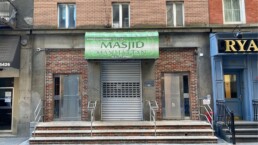
NEW YORK — A man named Sayeed, one of the mosque’s leaders, directs dozens of worshipers to line up in three rows before the Friday jummah prayers begin at Masjid Manhattan. Some men arrive late and find themselves hastily removing their shoes in the hallway and finding some of the few empty spaces among the three rows of men.
The modest mosque on 30 Cliff Street in Manhattan’s financial district attracts Sunni worshipers of all ages and backgrounds. The room reflects the diversity of New York’s Muslims: Arab, South Asian, Black, Caucasian. Each stands side by side in anticipation for Jummah afternoon’s two Rak’at (a series of prescribed movements and prayers).
But before each Rak’ah, the worshipers must recite the Fatiha or "the opener." The Fatiha is the first surah (chapter) in the Quran. Abdullah Hossain, a recent PhD graduate in electrical engineering, recites the Fatiha in the front of the room.
In the name of God the most merciful
All praise is for God, lord of all the worlds
The most compassionate
The most merciful
Owner of the day of judgment
You alone we worship, you alone we ask for help
Guide us along the straight path
The path of those you have blessed, not those you are displeased with or those you have led astray.
As Hossain leads the prayer, each man focuses their attention on themselves, tucking their chins and keeping their gaze lowered to the space directly in front of them. They interlock their arms across their chest, preparing themselves for the Rak’ah. Every line of the Fatiha reminds them of their purpose as Muslims.
Sheikh Mostafa Shekel, the leader of the congregation, explains the importance of the Fatiha. “We recite the Fatiha before every prayer. It is the beginning of everything we do.” The prayer represents the core tenets of the Islamic faith: God is one, he has no equivalent, he displays compassion and mercy, and will determine the fate of each person on the day of judgment.
The sheikh explains that as Muslims, they must follow the straight path as described in the Fatiha. “In Christianity, Jesus forgives the people for their sins and they are redeemed,” he says. “Islam is not like that.” In Islam, he adds, each Muslim must follow the path of Allah and strive for excellence in the path to prepare for the ultimate day of judgment.
After Hossain finishes the Fatiha, each worshiper bends forward and puts their hands on their knees. They then place their knees on the ground, and bow towards the front of the room.
Each man then whispers from side to side:
Subhana Rabbi Al Ala
Glory be to my lord almighty.
They are now spiritually prepared to pursue the path of righteousness.
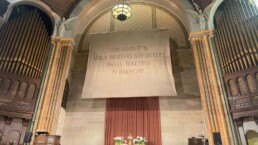
A Sacred Moment Between Rest and Work: Havdalah at a Modern Orthodox Synagogue
NEW YORK — In 1941, a group of 61 Jewish refugees from Luxembourg arrived in New York City. Narrowly escaping the impending doom of Nazi-orchestrated extermination camps in East Germany, the group fled to Lisbon, then sailed across the Atlantic to seek refuge in the United States.
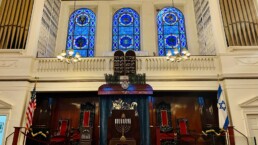
Despite pressures to assimilate fully into American culture, the refugees clung to their traditions, their community and their faith. The rabbi who coordinated their escape, Dr. Robert Serebrenik, found a half-completed Unitarian Church on the Upper West Side at 550 W 110th St. The church construction had been abandoned, and Serebrenik saw an opportunity. He purchased it and named the new synagogue Ramath Orah, “mountain of light” in Hebrew — a direct translation of Luxembourg, the home they had left behind.
In the looming space, the community gathered to pray, sing and eat. They rested from Friday evening to Saturday evening for Shabbat, and around sundown on Saturday, held maariv and havdalah to prepare for the week of work ahead.
Today, more than 80 years after the founding of the synagogue, those traditions continue. As the sun was setting on a recent Saturday evening, a 16-year-old named Ziv Siegel lights a thick white candle for Havdalah. Organ pipes from the unfinished church line the walls behind him, and the last rays of sunlight filter through a circular yellow and blue stained glass window gifted to the congregation by the government of Luxembourg.
Ziv begins to sing, and the small congregation who had gathered in the room, men and women separated by a cloth divider, joins in.
Baruch atah, Adonai Elohenu
Melech haolam
Borei p’ri hagafen
The melody is chillingly beautiful and drifts up to the high arching ceilings of the synagogue. The candlelight flickers on Ziv’s eyelids as he sings, his head bent down.
Congregants gather around him to observe the candlelight on their hands, flipping their palms back and forth and bending their fingers as if to beckon the light. The motion is a reminder of the light in the week and in life. To Ziv, this marks a departure from Shabbat, because lighting a candle is work that is forbidden during the prior day.
Ziv drinks the cup of wine, which seems to actually be grape juice, as a metaphor for the sweetness of the day of rest. Congregants sniff white mesh drawstring pouches filled with spices — one person says it’s cinnamon and cloves, another has no idea but says it smells nice — which fill the nostrils with a rich, earthy essence. During Shabbat, according to Ziv, the Talmud says a new soul comes to the body — a soul that brings peace, calm and rest. During havdalah, that soul departs. In order to rejuvenate the dormant souls tasked to work throughout the week, congregants smell the decadent spice. So begins the week ahead.
After Havdalah, Ziv and his father, Jonathan Siegel, say that the ceremony is a separation between holy time and the everyday. Ziv, who commutes an hour to an Orthodox Jewish school in Riverdale every day, says he feels deeply connected to the synagogue and the community. “It’s a lot of pressure,” he says about leading Havdalah. But the ritual, a quiet acknowledgement of the dichotomy of work and rest, peace and chaos, has given congregants over the decades a moment to acknowledge the passage of time, from the refugees who fled certain death in Europe to young practitioners like Ziv who are keeping their memories alive.