
Halal Grocers in Belfast Brace for Rising Costs Amid Global Trade Shifts
BELFAST, Northern Ireland — When Brexit first went into effect in 2020, Makkah Market’s Ramadan order came late. The owner, Mohammed Abdelnoor, has since learned that he needs to order products for Ramadan at least three weeks in advance to make sure they arrive on time. Much of his inventory, which previously came through Dublin, now must be routed through London, with some items originally sourced from the Middle East.
While halal food has always required careful sourcing, Brexit added new complications and higher costs. And now, as the U.S. seeks to add new tariffs on goods from around the world, merchants like Abdelnoor are feeling a new sense of destabilization. The longer and more complicated supply chain means that prices are rising — and customers are noticing.
“Now, when you get stuff from England, they have to declare it in customs,” Abdelnoor said. “It takes two days, then another two or three days — at least a week to get your stuff. Before, we used to get it next-day delivery.”
American tariffs now have merchants like Abdelnoor bracing for more delays and higher prices.
Even though Northern Ireland is officially a part of the U.K., it has an open trade border with the Republic of Ireland, making it subject to European Union tariffs from the U.S., which are set at a higher rate than those for the U.K. This could make prices even higher in Northern Ireland. Paul Krugman, a Nobel Prize-winning economist, predicts that firms in the EU will try to export goods through Northern Ireland to benefit from the lower tariff rate.
Halal food, which Muslims are required to eat according to their faith, cannot contain or be contaminated with any forbidden ingredients, such as alcohol or pork. Animals used for their meat must be killed in a specific way and only by a Muslim. The greatest demand for halal foods usually comes around the time of Ramadan, the holy month in Islam, which ended in late March.
Makkah Market is 2 miles south of another Belfast halal grocery, Zm Zm Market. Omer Ahmed, a co-owner, said he sees around a 10% to 30% increase in sales during Ramadan. Ahmed starts the ordering process for Ramadan about three to four weeks in advance. He plans for delivery to take about four to five days and factors in extra time to make sure the inventory will be there in time for the holy month.
“One of the biggest challenges we face is that, because the supply chain is so long — with things coming from the Middle East, India, all over the world — the price is usually slightly higher by the time it gets here,” Ahmed said. That’s a challenge because we’re selling halal lamb shoulder for about 12 pounds, while you can get the same cut, not halal, from a nearby shop for about 7 pounds to 10 pounds less.”
He understands it’s a tough sell for some families, even loyal customers. Like many halal stores in Belfast, Zm Zm Market is family owned — and even without the added trade costs, small businesses struggle to compete with the lower prices offered by supermarket chains.
“We have good support from our local customers, but we can't deny that it [high prices] is even challenging for them,” he said. “Some customers don’t mind paying 1 pound extra on a 5-kilogram purchase — they’ll get everything here. But others might not. They’ll come here for the halal meat, then go to another shop to get the rest of their items.”
Zein Ibrahim, 25, is one of them. A practicing Muslim, he sticks to halal for meat and a few other essentials but buys most of his groceries at mainstream stores, like Tesco.
“Throughout the year, the only things really that I would get from the halal shop is cheese, the certain type of cheese and the meat,” he said. “Everything else I'm getting from the local supermarket.”
While most halal food in Northern Ireland is not imported from the U.S., tariffs will have a more direct impact on halal markets within the U.S., according to several market owners in the U.S. Essa Massoud, general manager of Balady Market, a halal grocery store in Brooklyn, is already preparing for the potential effects. Although he recognizes that tariffs don’t uniquely impact halal businesses, he’s ordering food in advance to help the market prepare.
“The majority of citizens don't understand what these tariffs really mean,” Massoud said. “Many individuals think that these tariffs are a punishment for China. They're celebrating the increase of taxes or increase of tariffs on China, and they're celebrating without understanding that the actual effect is not to China. It's actually affecting themselves; it's affecting us.”
Balady Market, in Bay Ridge, plans to absorb the additional costs through its profit margins to avoid passing them on to customers. However, for countries where tariffs exceed 100%, like China, Massoud said it will be very difficult for the store to absorb those costs entirely.
Kashif Akram, 43, is one of six members on the executive committee at the Belfast Islamic Centre. The Islamic Centre feeds 300 to 400 people every Friday, Saturday and Sunday during Ramadan, using a mix of donated and sponsored food.
“Everyone's sitting together, eating and sharing their day — how it went, their food — and just mingling, and I thought it was wonderful,” Akram said. “And as the month went on, I’ve seen a big change in attitudes from the beginning, where the first day it was all pushing and ‘I want more,’ to people being very humbled throughout the period and getting to know each other, being more respectful, actually being more giving — ‘Here, do you want more?'”
Belfast’s Muslim community has kept its traditions intact despite rising costs of halal food. As global economic tensions and trade negotiations continue, small halal businesses in Belfast — and elsewhere — must navigate an increasingly uncertain future.

Blades Over The Burial Mound: The Fight To Save A Sacred Northern Ireland Site
RATHFRILAND, Northern Ireland — It all started in 2017 with a trench. That year, a power company was preparing to build a 135-foot-tall wind turbine near the summit of Knock Iveagh, a pre-Christian ceremonial hill outside the market town of Rathfriland.
Anne Harper, a musician and local whose spirituality is best described as “Celtic,” stared at the trench in disbelief. “We watched them dig a pit all the way around. I said, ‘They’re putting a noose around the hill.’ That was so hard to watch.”
For Harper, the view is even worse now. On a recent spring day, she pushed her way through a thicket of whin and gazed at the mountain as a white propeller sliced through the air, just visible over the crest. There — and there, again. Three blades turned endlessly in the distance. “There has been no justice,” she said.
The turbine wasn’t just an act of industrial development, Harper added. It was a spiritual and cultural rupture. “That place was my church. It was the place I felt most peaceful, you know, connected. A church with no ceiling.”
Adding to the desecration of the site is its new inaccessibility. For the first time in centuries, she said, public access to the Knock has been denied. Although the hill is widely acknowledged to be used publicly, it’s technically private land. After Harper led a small group to the summit for a winter solstice ceremony last year — honoring what many believe to be the hill’s ancient role in sun worship — she received a letter from the landowner warning they were trespassing.
The group Save Knock Iveagh is currently collecting testimonies from the local community to establish a legal right of way — a doctrine in UK law that allows for citizens to claim that a privately owned plot has been historically used by the public and should remain accessible as such. “That fight is time-bound,” Harper said. “If we don’t prove the public always had access, we lose that right forever.”
On last year’s winter solstice, a group climbed the Knock through the haze of early morning darkness. At the top, they gathered in a circle, listening to nothing but wind whipping through tufts of grass.
Niamh Mourne, a sound healer from County Down, began her prayer — a meditation, a connection to the earth and the sky. Mourne sang out to the wind. It replied, crescendoing through misty clouds and distant mountains. Drums began to pound, echoing on the ancient earth. The shy sun showed the crown of its head in the southeast. The group began to cheer. “It was as if we were being rewarded by a beautiful sunrise,” said Harper.
The threat to Knock Iveagh is not just a local issue. Eamonn P. Kelly, an Irish historian and archaeologist, said it’s a symbol of a wider reckoning between heritage and development across the Republic and the North. Kelly cited other cases where significant sites have been overlooked: a motorway built through the medieval Carrickmines Castle in Dublin; the construction over Viking remains at Wood Quay; a proposed wind farm in Galway Bay where 324-meter turbines would tower above the pre-Christian maritime pilgrimage site of MacDara’s Island.

“This thing should never have been put up,” said Kelly, who authored a historical study on the Knock’s ritual past. “It’s a very important location, and to stick a wind turbine on top of it is destructive and disrespectful.”
Knock Iveagh is a 5,000-year-old sacred landscape, crowned with a Neolithic burial cairn, connected to a web of archaeological features. Remnants of hazelnuts suggest celebrations of festivals like Samhain; 64 pieces of quartz sing of sun worship; layers of ancient ash hint at the glimmers of ritual fires. In the Middle Ages, the Knock was the inauguration site of the Magennis chiefs of Iveagh.
Doug Beattie, the elected Ulster Unionist Party Member of the Legislative Assembly for Upper Bann, said the Knock is “one of those key points” where tribal kingship emerged, “It predates the plantation. It predates all the arguments that we have. It’s incredibly important to understand how civilization here evolved.” Beattie said the Knock transcends political divisions, contributing to a layered cultural identity: “I am Irish. Of course, I'm British as well. I don't think there's a divide on this.”
Beyond identity, Beattie sees the Knock as emblematic of a deeper failure to protect the island’s sacred sites, “I mean, Knock Iveagh is older than the pyramids. We’ve thrown it away. And nobody really cares.” Beattie said there have been other instances where heritage destruction has occurred: Neolithic stones from the Ballintaggart court tombs were removed, placed in a museum but never displayed; planning permission was granted to build housing directly over a rath – an early ringfort – and an old grange in Waringston.
In the case of the Knock, Beattie called for immediate action. “The first thing is to get that wind turbine down. The second thing is to restore the place to the way it was. And the third thing is to give protected public access.” Beattie said he will be writing to The Minister for Communities, Gordon Lyons, asking for an outline of the public right of way at Knock Iveagh.
Despite the hill’s historic value, the turbine was approved in 2013 by the Department of the Environment (DoE), a since-devolved government department in the Northern Ireland Executive. But opponents of the development claim that no environmental or archaeological impact assessment was carried out — a fact that continues to anger Harper and members of the Save Knock Iveagh group, which has over 1,000 followers on Facebook. After the dissolution of the DoE, reform of local government in Northern Ireland saw planning powers transferred to local councils in 2015.
The application was greenlit, opponents of the development said, because DoE planners failed to consult archaeology experts from the Historic Environment Division (HED) who later said they would have recommended its rejection, as the BBC reported at the time. Information revealed to Save Knock Iveagh under freedom of information legislation showed that the Historic Monuments Council believed the turbine would have a “large/very large adverse impact” on the site’s historic position, the BBC also reported.
“In order to ensure that we have balanced development, there are statutory bodies in place,” said Kelly. “It’s a pity that people in the state, whose job it was to do precisely that, failed.”

Even with political support to remove the turbine, the question of who will pay if it is to be taken down remains unresolved. “This has now gone from what is a central issue to a localized council issue,” Beattie said. Though the DoE originally approved the turbine, it’s now the local Armagh City, Banbridge and Craigavon Borough Council that must decide whether to enforce removal — and foot the bill. “It would be in the millions,” Beattie said, referring to compensation costs the council would have to pay the turbine owner if planning permission were revoked. “The council would have to put that to the people of the borough.”
Beattie said the department that made the planning error should shoulder the cost: “The mistake was yours,” he said, “It’s up to you to sort out.”
The owner of the turbine, Ayr Power Ltd, is registered offshore in the Isle of Man. In a letter submitted to a Public Accounts Committee investigation into renewables incentives in Northern Ireland in 2021, Save Knock Iveagh alleged that the company responsible for the turbine had been in receipt of Renewable Obligation Certificates, government subsidies for energy generation, worth at least £299,250.
Ayr Power has not responded to repeated requests for comment.
The money may have flowed offshore, but the impact was personal — and not just for locals. Philadelphia-based Thomas McGinnis is an Irish American descendant of the mighty Magennis chiefs, a clan who ruled the territory of Iveagh which included the site of Knock Iveagh. McGinnis was on his annual pilgrimage to his homeland in 2023 when he learned about the hill.
Although his royal ancestors were inaugurated there, McGinnis has never been on the Knock. “I didn’t want to sneak up there or trespass. I don’t want to go there until everyone is able to, legally.”
“It just infuriates me,” he said. McGinnis believes the site would have been treated differently had it been located in the Republic of Ireland. “There, those sites are more protected. They’re part of the national story,” he added.
That sense of loss — not just of access, but also of community and culture — is part of what Harper and her group are trying to address. “We’ve tried really hard in this campaign not to go mad,” she said. “So, we balanced it with friendship, art and fun and research.”
The community has since organized storytelling walks and seasonal ceremonies.
“We re-established our narrative about what the site meant,” Harper said. “We can’t take the turbine down, but we’re not being victims. And that makes you quite powerful.”
As published in Religion Unplugged

An Interfaith Movement Grows in a Christian Land
BELFAST – The Northern Ireland Interfaith Forum typically meets over lunch, but at a recent gathering, the secretary, Edwin Graham, wouldn’t even have a cup of coffee. It was during Ramadan, the Muslim fasting month, he noted, and a fasting day for the Baha’i.
“Apologies to our Muslim friends who are fasting at the moment, and our Baha’i friends who are also fasting,” he said. It’s rare that Ramadan and the Baha’i Nineteen-Day Fast coincide, said Graham, who is a practicing Baha’i. “The Baha’i fast finishes today; we start celebrating tomorrow.”
The lunchtime gatherings happen every third Wednesday of the month and never get cancelled. But flexibility is required when bringing together believers from different faith traditions. It seems that someone is always celebrating, commemorating, praying or fasting. A few other members, neither Baha’i nor Muslim, responded that out of solidarity, they also wouldn’t eat the lunch provided.
“Holi, the Hindu festival, was last week,” Graham added. “So you have Holi happening in the middle of Ramadan, which is unusual, and then Pesach, the Jewish festival, happening towards the end of Ramadan. And Lent, of course. So you've got all these major festivals happening around the same time, and that doesn't normally happen.”
Interfaith may not be the first thing people think of when they hear Northern Ireland. It is a Christian land soaked in a history of strife between Catholics and Protestants. But Northern Ireland is changing. It is a far more diverse society today than it was a generation ago. The Northern Ireland Interfaith Forum was founded in 1993, five years prior to the Good Friday Agreement. The Forum’s goal is to promote mutual understanding and foster dialogue between the faith communities in Northern Ireland: Baha’i, Buddhist, Hindu, Jewish, Muslim, Sikh, Catholic, Protestant and other Christian denominations. They now regularly come together to learn from the past and look to the future of Northern Ireland.
Graham’s desire to form relationships with people from different backgrounds started at an early age — and during a time when those differences were becoming more polarized. “At the age of five, I was extremely upset because I couldn’t go to the same school as my best friend, because my best friend was Catholic, and I was Protestant,” Graham said.
Graham, 68, recognized that segregating groups of people based on religion was fundamentally wrong, and it was the catalyst for his commitment to bridge the Protestant-Catholic divide as he grew older. In the 1970s, he joined a peace movement, he said. In 1977, while in university and during the Troubles, he discovered the Baha’i faith and converted. “I adopted the faith because it teaches an acceptance of people of all religions. And that took me on an entirely different journey,” Graham said.
Shortly after he got married and started raising children, he founded The Northern Ireland Interfaith Forum. It was also a response to the struggle Graham experienced as he watched the way his two children, the next generation growing up in the country, received a lack of education on religious diversity in school.

But while the inclusive messaging of the organization hasn’t changed, the religious composition of the members, and the country, has. In 1991, census data in Northern Ireland showed that Protestants and other Christian denominations made up about 58% of the population and Catholics 42%. But in 2021, the two groups were almost tied: Catholics were 46%, while the Protestant and other Christians were 44%. Those not Catholic or part of a Christian denomination, or who don’t identify as religious, are part of an increasing number of minority religious groups in Northern Ireland.
Muslims represent 0.6% of the population in Northern Ireland, according to 2021 census data. Many of them are immigrants who came to the country after the Troubles.
There are currently about 50 active members of The Northern Ireland Interfaith Forum. Muslims, who are now the majority religious group reflected in the organization’s Board of Trustees, are also people with a distant connection – or none at all – to the troubled history of sectarian violence and political tensions in Northern Ireland. And while the organization itself identifies as non-partisan, members of the group are actively engaged in politics and meet regularly with the various political parties.
Of the more discussed political topics: The idea of a shared future between the jurisdictions of Northern Ireland and the Republic of Ireland.
“It’s very actively an issue for us,” Graham said. He noted a human rights lawyer from Queens University spoke to the group on Human Rights Day in December. “He said that the discourse around a shared island is developing, and he challenged us by saying that faith forces are not present in that discourse — and that we need to be.”
While Graham says that The Northern Ireland Interfaith Forum is comfortable facilitating meetings from opposing political perspectives, the group wouldn’t be comfortable to take any position or align themselves with a specific cause. Raied Al-Wazzan, who is not a member of The Northern Ireland Interfaith Forum but is actively involved in the Belfast Islamic Centre, said that on Fridays, members from political parties such as Sinn Féin and Alliance stand outside their mosque to greet their community. He also said that if there is a shared island between Northern Ireland and the Republic of Ireland, it will be the ethnic minorities in Northern Ireland that will swing the vote.
“Sinn Féin is actively recruiting asylum seekers,” Graham said. Sinn Féin is the former political wing of the Irish Republican Army seeking a shared island.
Kais Aloui is an asylum seeker from Tunisia who traveled about two hours to be at the interfaith meeting in Belfast. He arrived in Northern Ireland a year ago and joined The Northern Ireland Interfaith Forum because he was looking to find a community that brought together people from different faith backgrounds.
“I come from an Islamic country; the majority are Muslim. We don’t have the same interfaith like Europe,” Aloui said. Unlike his experience in Tunisia where he was part of the Muslim religious majority, he is now part of a religious minority in Northern Ireland.
The Northern Ireland Interfaith Forum promotes peace and reconciliation through frequent opportunities to come together. While the meetings have a more formal agenda, it’s the informal lunches and gatherings where trust and friendships are developed.
“A lot of the activities that we’ve done over the past year start off with a chance conversation or a chance remark,” Graham said.
Mutaraf Ahmed, an Imam and member of the Ahmadiyya Muslim community from England, discovered the organization through a Facebook advertisement after he arrived in Northern Ireland in 2023. He was seeking organizations that carried out an interfaith dialogue and that worked to build a more peaceful society.
Ahmed noted that global events, especially in the Middle East, have led people to raise questions about Islam. He strived to inform people about how his religion can be misunderstood — that extremists acting in the name of Islam actually defy the religion’s teachings.
“There would be a lot of negativity around those conversations online,” said Ahmed. “In person, when you're meeting in such an informal environment, it's so much easier to have those conversations, especially when you build that friendship. Because when that is there, people are more open to ask those questions which they may have in the back of their minds and which they might not be able to ask if they've just met you the first time.”
Paul Fitzsimmons, a convert to the Soka Gakkai sect of Buddhism, said his religion’s motto is trust through friendship, peace through trust. “There’s such a lack of trust and that’s where a lot of conflict arises from when there's mistrust of the other,” Fitzsimmons said. “So the importance of having dialog can’t be over emphasized. Regardless of what our faith tradition is, it's our common humanity that's the important thing. And we all, I think, desire to have peace and happiness and coexist together.”

Graham does not want history to repeat itself. Regardless of a member’s religion or connection to the history of Northern Ireland, people in this organization can come together if there is a desire to develop an appreciation of each other’s beliefs and cultural diversity. In many ways, this organization is a mirror to the younger generations who have already learned this lesson.
“I have a virtual connection to the Troubles," Aloui said. "Because when I was in Tunisia, we watched a lot about the Troubles on TV. I came here and found another reality. I have big respect to younger generations. They live together without any problem.”
Today, Graham watches his grandchildren engage in interfaith relationships in school in a way he never could. “So my granddaughter is 10, and her best friend of school is a Muslim, and her friend’s parents came here as asylum seekers,” he said. These children are raised without the same connection to the past; yet, they are able to move forward from the conflict.
“For my grandchildren,” Graham said, “it's just a relationship.”

In Belfast, a Small Jewish Community Reaches Out to its Christian neighbors
BELFAST, Northern Ireland — On Saturdays, the Jewish day of rest and prayer, there is barely a quorum of 10 at the old synagogue in Northern Ireland's capital city. But every other Wednesday, the place is hopping. A gaggle of seniors gathers for lectures, conversation, lunch and socializing. Only some of them are Jewish.
“I come here mostly for company. I see my friends, and I enjoy the talks. It gets me out once a fortnight,” said Norma Simon, 94, one of the members of the synagogue. Non-Jewish people, like Eleanor Minahan, who is Catholic, come to the meetings because they enjoy the conversations. “Most of the people that I meet here, I don’t meet in any other circumstances,” said Minahan.
Hilary Shields and Carolyn Hiltitch go to the same Anglican church on Sundays, and every two weeks they join the Wednesday Club. “[The meetings] are informative, entertaining, sometimes boring,” said Shields. “They make us feel very welcome, and it’s nice to be with friends.”
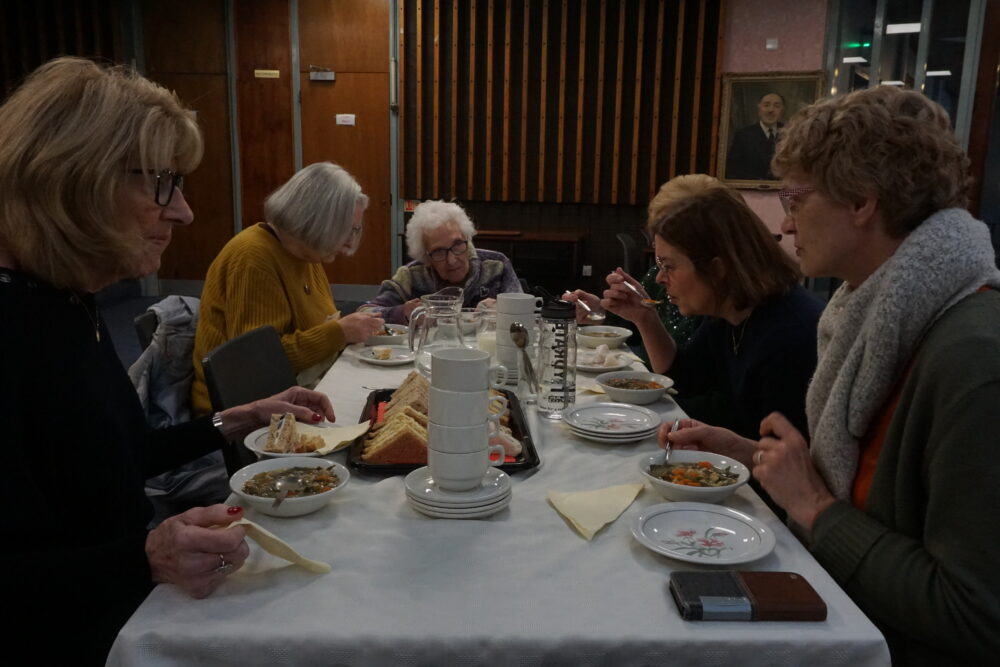
The Belfast Jewish Community & Hebrew Congregation started these meetings in 2009 to encourage more time together and connect with people outside of the Jewish community. “To stop just being inward-looking, to be more outward-looking,” said Jane Danker, the organizer. “And as you can see, we all mix and match.”
About 30 seniors, in their 70s, 80s and 90s, join the biweekly meetings, called “Wednesday Club.” Common activities include hearing speakers talk on a wide range of topics, playing trivia games, listening to music and sharing a meal.
By talking about topics that are common to any faith, the community tries to find common ground with its non-Jewish neighbors. “We’re so few that everybody matters. We try to come to make up the numbers,” said Shoshana Appleton, one of the Jewish members. Only 439 people identified as Jewish in the latest Northern Ireland census, taken in 2021. This represents a steep decline from the 1960s, when there were a few thousand Jews in Northern Ireland. The downward trend is in contrast to the rest of the United Kingdom, where the number of Jews has increased almost 6% in the last 10 years, with 287,360 people in England and Wales, according to the 2021 census.
The synagogue, known as the Belfast Hebrew Congregation, is the only one in Northern Ireland. It sits in a mixed, but mainly Catholic, neighborhood in North Belfast and is an architecturally round synagogue with beams that form a Star of David on the roof.
When it was built in 1964, it was a house of worship for 1,500 Jews. Today, it serves only 54 active members, mostly retired people with no children. They hold services weekly for each Saturday and on the main holidays. Over the years, the synagogue was renovated so that there is less room for worship and more space for meetings and social activities.
“When everybody left, we condensed it, we built this wall and we turned this into a functions room,” said Ivonne Danker, an active member of the Belfast Jewish Community, gesturing around the synagogue. She explained that the big exodus of Jews from Northern Ireland occurred during the Troubles, a period of conflict between the late 1960s and 1998. “That was our future generation — gone.”
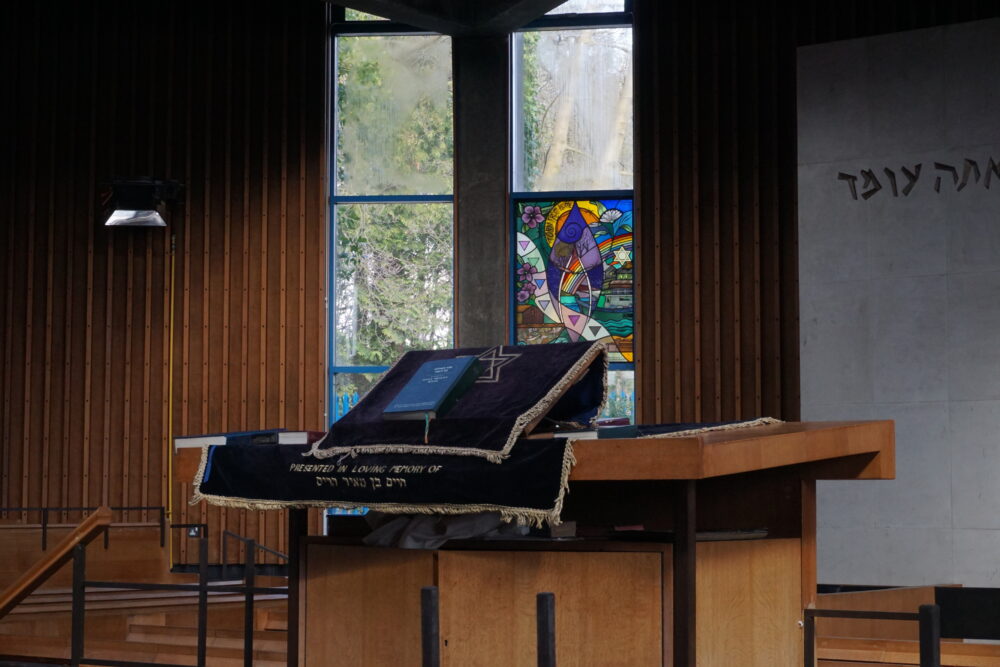
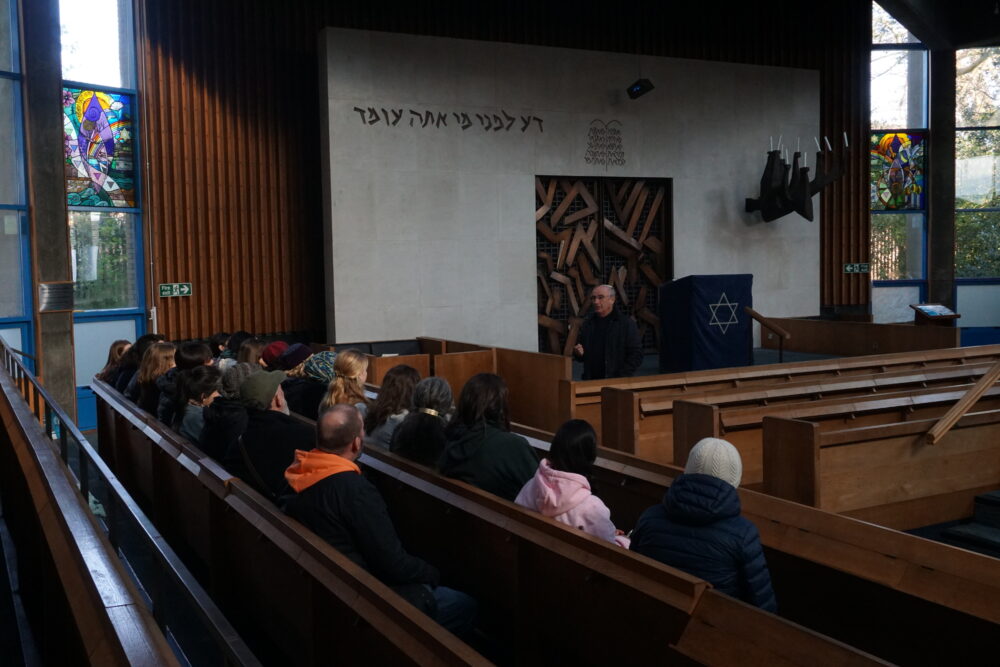
In addition to the Wednesday Club program for seniors, the synagogue gets visitors from Northern Ireland and abroad who are interested in learning about Judaism. On a recent spring day, the deputy chairman of the Belfast Jewish community, Michael Black, gave a tour to a group of 21 American students visiting from Middlebury College in Vermont. He showed them the sanctuary, which faces Jerusalem, and the Holy Ark, which contains the Torah scrolls.
The visit of the group, composed of students and professors from the class “Conflict: Transformation in Northern Ireland,” ended at the Yahrzeit Wall, a special room where the names of the deceased are remembered and commemorated by the community. There, Black explained that during the anniversary of a loved one’s passing, a Yahrzeit light is lit in their memory.
The immediate challenge for Belfast's Jewish community is to find a new rabbi after six years with Rabbi David Kale. The community leaders are aiming to have someone outgoing and “receptive to other groups of Jews” by June 3. They are looking for someone who can lead prayers and teach Bible classes as well as help the Chevrah Kadisha, a citizens’ group that helps prepare the dead for a Jewish burial. Additionally, the community hopes to reach out to the Jewish students at Queen’s University Belfast with the hope that they will use the space for meetings and Shabbat dinners on Fridays.
As the Jewish community of Belfast is getting smaller, the leaders are rethinking the future. The synagogue is a Listed Historic Building of the Northern Ireland Department of Communities, which means it is protected by legislation and, therefore, requires consent for alterations.
Black imagines the synagogue could become a cultural center, a museum and an educational center.
“I think it’s only a matter of time before we disappear as an Orthodox community,” he said. “I would like to leave a legacy.”
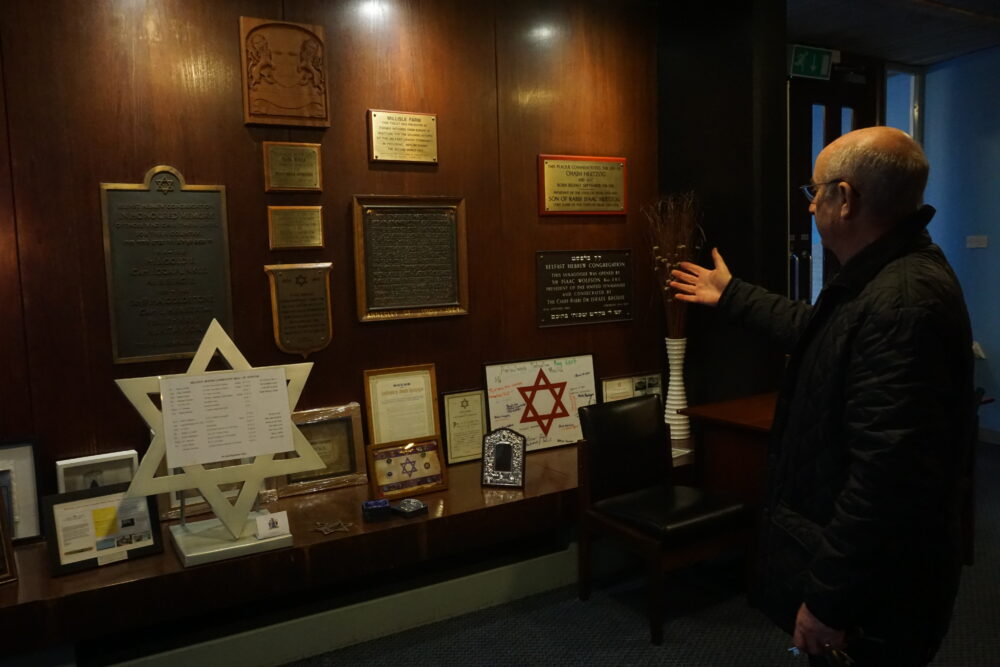
Photo at top: The Wednesday Club at the Belfast Jewish Community meets every two weeks. (Photo by Rosario del Valle)

West Belfast Musicians Are Standing Up for Palestine
BELFAST, Northern Ireland — On the eve of Saint Patrick’s Day this year, locals gathered to ring in the holiday at a local club with a musical display of Irish indigeneity. Amid shouts and cheers, Stephen Loughran, an Irish trad musician donning a druid-inspired ram skull, declared collective ancestry from the mythological warrior-hunter Fianna in Irish. He finished with a rallying cry — “Long live the revolution!” — and a fist in the air that was emulated by most of the crowd.
As Loughran and his band, Huartan, led the audience in a celebration of a precolonial Ireland, they also championed a second cause: Palestine. And after a few songs with electric lighting and well-crafted choreography, the Palestinian and Irish flags flew together across the stage.
In West Belfast, music groups like Huartan are using their platforms to promote the Palestinian cause in a variety of ways, ranging from visual solidarity statements in live performances to fundraisers, protest songs, music videos and Instagram activism.

West Belfast, a staunchly Catholic republican area of the city, where much of the violence of the Troubles took place, is a hot spot for pro-Palestine activism. The Falls Road and Northumberland Street are filled with murals depicting scenes from Palestine, civil rights leaders and Irish republican heroes like Bobby Sands. In many community spots, the sounds of the Irish language and Irish traditional music are equally as ubiquitous and just as political as the murals.
In Ireland, and in Belfast specifically, music has long been a means of activism and protest. In a place where the Catholic community was historically ostracized and forced into silence, music and art became primary ways to spread controversial or forbidden republican ideas. Rebel songs, a genre of Irish folk music themed on rebellion and Irish independence, are a rich tradition in the region.
Music, poetry and story “was one of the main formats through which Irish people could express resistance against colonialism,” said Don Duncan, a journalist and professor in the School of English, Media and Creative Arts at the University of Galway.
“It’s a new iteration of a very old tradition,” said Duncan, describing the rise of pro-Palestine activism among Irish musicians.
Out of West Belfast, where many rebel tunes originated, new artists are continuing the legacy of protest. Kneecap, an Irish-language hip-hop group from West Belfast, has garnered international attention for their public support of Palestine and Irish republicanism.
Ties between Ireland and Palestine have existed since the early 20th century, said Andy Clarke, a local historian from Belfast and creator of the Irish history Instagram page "tanistry." Because Ireland was Britain’s first colony, many of the colonial methods later used in other parts of the world were developed there. Some of the British colonial strategies first used in Ireland include land confiscation, militarized policing, resource control, sectarian division and cultural suppression.
There are Irish people today who have been “burned out of their homes, and they’re just seeing it happen somewhere else,” said Clarke.
They also share direct links, he explained, referencing the Black and Tans, a British paramilitary force that moved into Palestine after gaining a reputation for violence in Ireland, and Arthur James Balfour, who served as both Chief Secretary for Ireland and famously wrote the 1917 Balfour Declaration, which announced British support for the Zionist movement.
“[A similarity] that strikes a massive chord, I think, culturally, is that use of religious divide to oversimplify it,” said Clarke. Although armed conflict ended in 1998 with the Good Friday Agreement, the divide between Catholic republicans and Protestant loyalists is still evident in Belfast today.

For those who grow up in West Belfast, anti-colonial ideas are taught in households, through art, music and the community’s history and lived experience.
“When I was growing up in the house, I would’ve had an awareness of Cuba, Palestine, Kurdistan, the Congo, South America,” said Jake Óg Mac Siacais, whose father was a formerly incarcerated Irish Republican volunteer and whose mother worked for an Irish festival. As a young child, he occasionally visited his mother’s father in England, who was in prison for IRA activity.
“My first exposure to [Palestine] was through being just a republican from West Belfast,” he said.
Mac Siacais is the frontman and lyricist of The Shan Vans, a West Belfast rock band of Irish-speakers, formed in 2023, who released their Irish-Palestinian solidarity anthem "The Shan Van" in February. The song and accompanying video is a collaborative project with over 100 contributors.
“Shan Van,” from the phrase “Shan Van Vocht,” is directly translated as “the poor old woman.” The Shan Van Vocht has a rich history as an allegory for Ireland in colonial bondage, an image sometimes used to bypass censors while commenting on colonial oppression.
In “The Shan Van,” one rendering of this idea is the symbolic nature of a mother grieving for her son, which is evident in many of the art pieces and lyrics.
Mikey Cullen, a Dublin-based poet and collaborator on the project, took inspiration for his part from the influential women of Irish history and the important relationship of nationalist activists to their mothers, citing poems Patrick Pearse and Bobby Sands wrote for their mothers before their deaths.
“The naked light of the sun / Screaming down the ages / Who is the Shan Van Vocht?” sings Mac Siacais in Irish.
Using the overarching symbol of the Shan Van as a representation of colonized peoples, the song depicts solidarity between Ireland and Palestine through their shared experiences of colonialism, with hope for the future.
“We’re a rock band, and we’re singing songs about decolonization,” Mac Siacais said, describing the core focus of the band.
Instead of the trivial signs and slogans that typically show up in concert crowds, Mac Siacais described instances of concertgoers shouting liberation quotes and flying Palestinian flags, something he appreciates.
For The Shan Vans, music is a form of activism.
“It should be about politics; it should be about ideology,” Mac Siacais said.

This action-oriented attitude is common in West Belfast, where a large part of the violence of the Troubles took place. Maddens, an iconic republican pub in the Cathedral Quarter frequented by Mac Siacais, is decorated inside with images and mantras of Palestine, South Africa, the American Civil Rights movement, IRA leaders and the word CEARTA, Irish for “rights.” Outside, the pub reflects the current republican movement, with a large mural that references several local bands and artists.
One of these illustrations, Mac Siacais points out, is local tradtronica (a blend of Irish trad music and electronica) band Huartan’s hawthorn tree, the origin of their name, and a sacred figure in Irish folklore that represents the gateway to the Otherworld and symbolizes protection.
Huartan, another West Belfast band, fuses the Irish language, precolonial tradition and Palestinian solidarity. Stephen Loughran and the other two original members met while working as trad musicians in the Hawthorn Bar, a West Belfast neighborhood gathering place.
About a month before Loughran's birth, on March 16, 1988, a family member in the IRA was shot and killed by a loyalist paramilitary in what is known as the Milltown Cemetery attack. Like Mac Siacais, Loughran was born into a world where he was candidly aware of the pervasive politics surrounding him, in a neighborhood covered in Irish and Palestinian flags.
Loughran described Huartan’s work as a “rejection of the systems of oppression.”
In their songs and performances, Huartan tries to capture an Irish identity detached from colonialism — a response to the injustices and loss of culture stemming from British colonization.
“That’s maybe a way that we connect when we see that sort of thing happen in other places — Palestine being the most obvious example at the minute,” said Loughran.
Last year, the band released the song "Fiáin,"Irish for “wild.” It uses the melody of “The Foggy Dew,” a famous Irish rebel song about the 1916 Easter Rising, and audio snippets from Bernadette Devlin McAliskey, a prominent Irish civil rights activist and former politician. The song and music video promote the 2024 campaign against Sinn Féin attending the White House’s annual Saint Patrick’s Day celebration due to the Biden administration’s support of Israel.
“We wanted to just essentially try to elevate [McAliskey’s] words, to be part of a campaign,” said Loughran.
The band describes the project as a “plea to Irish politicians to remember our own history and struggle and to stand in true solidarity with the people of Palestine.”
In their personal lives, both Loughran and Mac Siacais are just as active as in their art. Apart from music, Loughran works at the Cultúrlann, an Irish cultural center that he described as “an incubation center” for the Irish language and culture, and Mac Siacais works for Fóram na nÓg, an Irish-language youth organization.
For both Loughran and Mac Siacais, the Palestinian solidarity movement is part of a larger cause; it is a fight for universal civil rights and decolonization.
“This is more than just Palestine that we’re talking about here," Mac Siacais said, "and that’s why we’re talking about it so passionately.”