
Ireland Long Ago Closed Mother-and-Baby Homes, but Their Painful Legacy Remains
LONDONDERRY, Northern Ireland — In May 2024, Billy Scampton from Londonderry and Shannon Ritchie-Leet from Ontario, Canada, walked to the edge of River Strule in Omagh, Northern Ireland. Together, they scattered the ashes of their mother into the water and watched as the river carried them away.
The two siblings may have been sharing an intensely moving moment — but they were recently strangers. In fact, they had just met several months prior through social media.
A year earlier, Shannon had posted on Facebook that she was planning a trip to Ireland and wanted to know more about her ancestry and the family of her mother, Moya Beckett, who immigrated to Canada from Ireland as a young woman and died of dementia in 2019. Shortly before Moya passed, she told Shannon that when she was a teenager, she was forced to give up a little boy she had given birth to in Northern Ireland.
That baby boy was Billy, who is now 62 years old.
Billy, meanwhile, who was adopted as an infant, had been searching for his birth mom for over a decade, after both his adoptive parents passed away. But he had no leads until he came across Shannon’s public post, which included the one detail he knew about his mother — her name.
“[That post] ticked all the bells and whistles,” he said. “Truth be told, it scared the friggin’ life out of me.” Billy reached out to Shannon.
“Shannon, I am your mommy’s little boy,” he wrote to her.
Billy had spent the first few days of his life at Marianvale, one of many mother and baby homes in a network of institutions across the country, located in Newry, Northern Ireland. These institutions — as well as Magdalene laundries, or asylums — were run by both Catholic and Protestant clergy in Northern Ireland and the Republic to rehabilitate “fallen women,” mostly unwed mothers to be.
Moya’s mother, a Catholic, secured her daughter a place at Marianvale to bring the baby to term and give him up for adoption. The institution was run by the Good Shepherd Sisters, a Roman Catholic order of nuns.
Billy is one of tens of thousands of Irish people born in these homes in the 20th century. Like many others, he is trying to honor the woman who gave birth to him and reckon with this dark period in Irish history.
Marianvale, which saw an estimated 1,399 women from 1955 to 1984, was a place of pain and humiliation, Billy said.
“I think the whole experience dogged her all her life,” Billy said. “She was forced to give up her firstborn and was sent away, basically plucked out like a weed out of a driveway.”
“It had a severe impact of suppressive trauma,” he added.
These institutions are now widely known to have been abusive, including through unpaid work and forced adoptions. Testimonies collected from survivors noted that staff were cruel and made the women feel ashamed of their pregnancies, and birth preparation was deficient, according to a report by researchers at Ulster University and Queen’s University in Belfast.
Thousands of babies died across the country at these homes. In 2017, a mass grave with the remains of 736 babies and children was discovered at a former mother and baby home in the Republic of Ireland.
Though Billy never visited Marianvale, which is about 80 miles — or two hours — from his home in Londonderry, a friend gifted him tiles from the floor of the institution.
Billy, a Reiki master, immediately tuned into the energy he picked up from the tiles.
“The first thing I sensed off them was pain and anguish,” he said. “They were a place of sorrow.”
The tiles are a remembrance of a place now gone. Marianvale was demolished in 2021, a decision Billy said he mostly supported, with a stipulation.
Preserving the site, he said, would have been macabre. “But there should be some sort of a memorial on site there.”
How the sites are handled is a point of contention for some survivors. Though many of these institutions have been demolished, a number of survivors in the Republic of Ireland and Northern Ireland have pushed for preserving the remaining sites. In January, women who suffered institutional abuse at Dublin’s Sean MacDermott Street laundry, the last-standing Magdalene laundry in the Republic of Ireland, protested plans to develop the site.
The building has been vacant since the institution closed in the 1990s, and the Office of Public Works had planned to renovate it into a memorial space and research center. Survivors, however, felt they weren’t properly consulted and see the development as more of a “vanity project,” according to The Irish Times.
The same is true in Northern Ireland, said Mairéad Nic Bhloscaidh, who is leading a digital exhibition on Marianvale through Sole Purpose Productions, a social-justice-aimed theater group in Londonderry. “The place seems to have a very strong pull for [survivors],” she said.


Moya Beckett lived at Marianvale from June to September 1962. Billy was born in late August. At just a few days old, he was taken to Nazareth House, a baby home in Fahan in the Republic of Ireland, to be put up for adoption.
His mother left Marianvale the day after him, and within a year, her family sent her to Canada, where her sister lived. She never came back. And Billy never knew what happened after that.
That was, until he met Shannon, who was able to fill in some of the gaps about their mother’s life in Canada. She married there and later gave birth to two more children, a son named David, now 60, and Shannon, now 51.
After the two half-siblings connected on social media, Shannon took the trip to her ancestral homeland and visited Billy and his wife, Moira. They scattered their mother's ashes — and three roses, one for each sibling — five years to the day she told Shannon that she’d had a son in Ireland.
Since that trip, about a year ago, the two have continued to text and call one another, including on holidays. They have fallen into a natural sibling rhythm — bouncing thoughts off of one another and noticing their similar feet and left-handedness. Billy plans to visit Canada this year.
“It’s just the most profound experience of my life,” he said. “She’s the most incredibly smart girl I’ve met.”
Shannon hoped to learn more about her Irish ancestors before she visited Ireland a year ago and instead found a brother. The running joke, Billy said, is that she came looking for the dead and found the living.

The reunion was also bittersweet for Billy. “It was quite sad,” he said. “On one side, I was relating to the death of my birth mother, and on the other side, I [learned] I had a sister.”
He’s had to wrestle with the generational trauma often experienced by adopted children. “When they’re being carried by their mother, all the pain, everything that the birth mother has been subjected to, all the fear and whatnot, that’s also transmitted into the baby they’re carrying through the placenta. They absorb that there as well, too,” he said.
The ultimate betrayal, he said, is that the bond between the birth mother and the baby is severed irrevocably when the child is taken from them.
Although he was only a newborn and can’t recall how he felt in that moment, the trauma of being separated from the body he was attached to for nine months and who had nurtured him is a pain that he carries as an adult. It's like a hand cut off, he said. “That is something I’m working my way through.”
Billy was adopted by Ben and Vera Scampton of Londonderry at the end of 1962. “I carry my birth mother’s DNA, but it was Ben and Vera who are the people who raised me and made me into the person I am today,” he said.
Billy still wears his adoptive status as a badge of honor, he said, and it instilled in him a strong sense of right and wrong.
“Probably from what happened to [my] mother,” he said, “I don’t do injustice.” Though he doesn’t have children, Billy is also involved in student life at Ulster University as a soccer coach and mental health well-being first responder.
Conversations around Magdalene laundries and mother and baby homes are long overdue, said Dr. Livi Dee, an oral historian who is a testimony facilitator for the Truth Recovery Independent Panel, which is investigating how these institutions operated. Their work is part of a public inquiry and redress scheme for survivors in Northern Ireland.
In 2021, after the Commission of Investigation into Mother and Baby Homes submitted a final report to the government a few months prior, the Taoiseach (Irish prime minister) Micheál Martin issued an apology on behalf of the state for the “profound and generational wrong” that resulted in high infant mortality in these institutions.
The executive office called for an independent investigation, and since April 2023, the panel has worked to gather evidence and collect testimonies of survivors. The deadline for people to register to give testimony is May 1.
By participating, survivors are not just seeking compensation, noted Dee. “It's a recognition of what they went through.”
Billy, who gave testimony to the panel, is also personally seeking that public acknowledgment and remains angry at the religious orders that allowed these facilities to operate. He demanded that legislation be passed to ensure all remaining records are preserved and noted that adoptive children have been denied knowledge of their familial medical history — what he calls their ground zero. He didn’t even learn his mother’s name until he requested his baptismal records prior to his marriage.
“The religious orders can say, ‘We’re heartily sorry for this. This shouldn’t have happened,’" he said. “But that’s all from the teeth out. They’ve made a dangerous thing seem harmless.”
He tries to find the silver lining — noting he is blessed by having two mothers instead of one. But still he’s committed to maintaining the memory of Moya.
“It is important that the story is told,” he said. “There’s not a day that [goes] past that I don’t think about her.”
A Modern-Day Passion Play on the Walls of Londonderry Reimagines Jesus’ Final Days
LONDONDERRY, Northern Ireland — Jesus, understandably, is the star of most Passion Plays. The story of Christ’s Passion, derived from the Latin word “passio,” meaning “suffer” — recounts the final days leading to Jesus’s crucifixion and death, based on accounts in the four Gospels of the Christian Bible. In the Northern Ireland town of Londonderry, however, Jesus gets second billing.
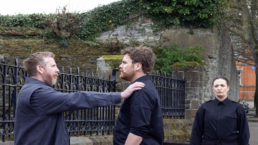
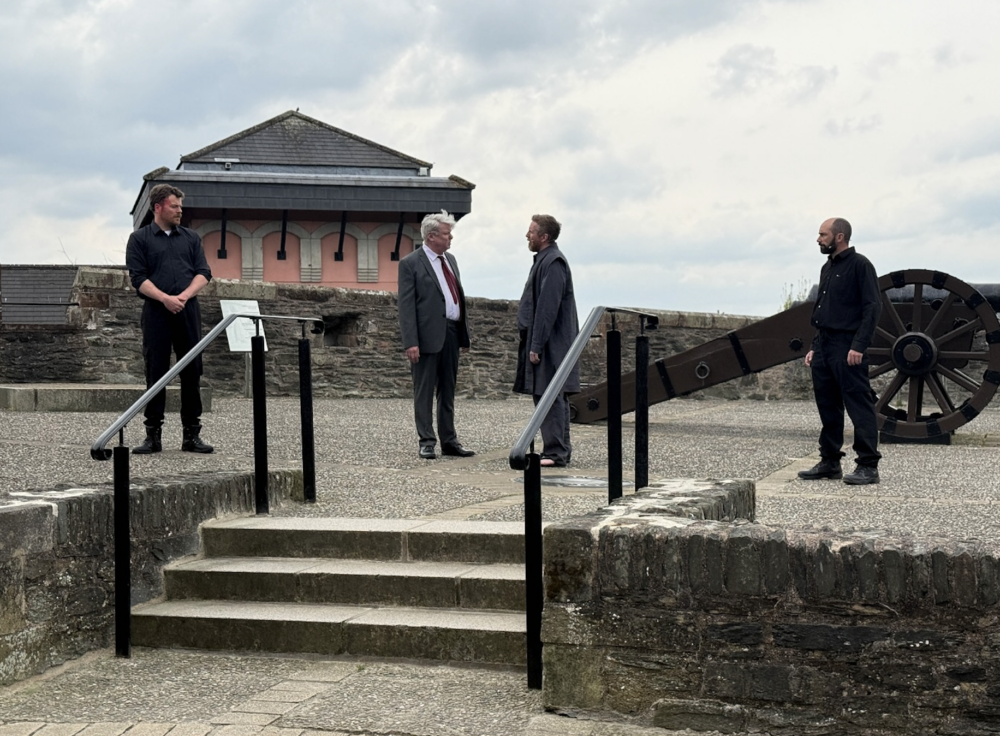
Londonderry’s “Walled City Passion,” a live, outdoor dramatization of the Passion Play set in modern times, takes some liberties with the Gospel stories. Last year, for example, Pontius Pilate’s wife, Claudia, and Jesus’ friend Mary Magdalene took the spotlight. This year’s lead character was Dave, one of four guards charged with delivering Jesus to his death. Dave wears a navy blue protective vest printed with “IST” (short for Internal Security Team) in white block letters, a black long-sleeved shirt and pants, and combat boots. He’s just doing his job as he joins his fellow officers in arresting a rabble-rouser. Then, he develops a conscience.
“We are delivering this man to be killed,” Dave says in the play. “And for what? Because we were told to.”
The production, now in its fourth year, takes place on the storied 400-year-old stone walls that surround the city center of Londonderry, also known as Derry. Jonathan Burgess, the playwright and director, is not interested in portraying Jesus as SuperMartyr, or transforming his crucifixion into a histrionic spectacle. He presents the Passion each year from the point of view of lesser-known figures in the hope that viewers, whether or not they are religious, will relate to the characters and find the story more relevant.
It is not, Burgess said, about the Catholic/Protestant divide that this city was once famous for, and characters like Jesus and Judas don’t represent real historical figures: “We wouldn’t draw those kinds of connections, because it depends on what it represents to the community. People make their own connection.” He has no special message about peace and coexistence; it is just about developing a better understanding of the central story of Christ’s resurrection.
For Christians of all denominations who do find religious meaning in the Passion, he said, “we’re trying to provoke you to be more actively engaged.”
Passion Plays, first performed in Latin during medieval times throughout Europe, then in vernacular languages, are still popular around the world. During Holy Week, from Palm Sunday to Easter Sunday, Christian churches of all denominations usually present a dramatized version of the Passion. Parishioners might read the Gospel passages during a service, or clergy might read from a script as they take on the roles of Jesus, his disciples and others, sometimes with congregants reading the parts of the crowd, who yell, “Crucify him.”
Some churches go to great lengths to reenact the story with costumes, music, props and special effects. The action reaches a climax when a bloodied, beaten Jesus is nailed (usually by ropes) to a cross. Although old productions of the Passion Play were notoriously antisemitic and depicted Jews as conniving Christ killers, most of those versions were purged of such bigotry after the Second Vatican Council of the mid-20th century. The “Walled City” version has none of those canards.
Burgess is known for his quiet but probing plays that re-create the real stories of working-class people during the Troubles — the period of religious and political strife in Northern Ireland from 1968 to 1998, when the majority Catholic/republican population, who wanted to join the Republic of Ireland, fought with the ruling Protestants/loyalists, who wanted Northern Ireland to remain a part of the U.K.
Although Burgess, 53, is proudly Protestant, and grew up during the Troubles, he is committed to peace and reconciliation with Catholics. Burgess said he and Archdeacon Robert Miller of the Church of Ireland, who have worked together on peace-building in Londonderry, came up with the idea for “Walled City Passion” five years ago when they noted that many Christians had distanced themselves from the Easter holiday. They worried that “people like to park Easter and look at it,” Burgess recalled during an interview at the Londonderry offices of the Church of Ireland. “They don’t want to actually engage with it. They want to observe it from far away and ‘over there,’ where it’s safe. We’re trying to make it a wee bit more dangerous.” People from all Christian faiths, as well as those who don’t consider themselves religious, attend the performances.
The “Walled City” of the title refers to the historical stone walls in Londonderry, built from 1613-1619 to protect English and Scottish settlers. All the action in “Walled City Passion” takes place on or within these walls, which form a 1-mile walkway around the city center and range from 12 to 35 feet high. The walls have never been breached, even during a 105-day siege in 1689, which is why one of Londonderry’s nicknames is “the Maiden City.” They were closed down and suffered damage during the Troubles, but reopened to the public in 1995. “The most significant thing we can do is bring people back onto them again, to a place that was once seen as confrontational,” Burgess said.
The changes Burgess makes to “Walled City Passion,” however, are not expressly about the Troubles, and well-known characters like Jesus and Judas don’t represent real, contemporary historical figures, he said: “We wouldn’t draw those kinds of connections, because it depends on what it represents to the community. People make their own connection.”
“Walled City Passion,” this year with performances in the days leading up to Easter, began at the Church of Ireland offices inside the walls, then moved to the gardens of St. Columb’s, an Anglican cathedral built in 1633. Scenes took place at 10 stops along the walls, including historical gates and artillery bastions with space for staging, ending outside the neo-Gothic Guildhall government building. Much of the movement occurred on the wide Grand Parade portion of the walls, which fans of “Derry Girls” might recognize from the finale of the Netflix sitcom, when Erin’s cousin Orla dances joyfully there with a group of young Irish dancers.
The show must go on in all types of weather, including rain, wind and snow. One of the actors, Susie Garvey-Williams, who last year played Mary Magdalene, said the weather sometimes intervenes in unexpected ways. She recalled how last year, Caiaphas, a high priest, was berating Jesus, and suddenly the heavens opened, and snow poured down. “Sometimes you have those moments you’d never have in a theater,” she added.
Audience members don headphones to hear the actors, who wear microphones. When the audience moves from one setting to another, they listen to a recorded narration that guides them. The walls are a popular community and tourist attraction, so residents and visitors, too, wander along as usual during the play.
This year the main cast comprised 13 professional actors, with extras from a local performing arts college.
The play starts out with Dave getting a call at home to report to Gethsemane, the garden where Jesus was arrested, to handle a routine civil disturbance. Dave “is cynical, brutal and tired, but … we also see his loving side” as he interacts with his fiancee, Burgess said. In the garden, a disciple stabs Dave, but Jesus heals him (in the biblical story, Jesus heals a servant whose ear is cut off). Once the “miracle” of healing happens, Dave’s perspective starts to change. As he and the other guards march their prisoner to his demise, Dave comes to see Jesus as a savior rather than a troublemaker.
Garvey-Williams played a guard in this year’s production. Unlike Dave, her character, as a new recruit, “is very much about doing what the sergeant says, and following orders,” Garvey-Williams said. “And my last line is, ‘We were only doing what we were told.’ I think that idea is very important. What orders are we all following today? We try and step away from our responsibility for the actions we choose sometimes as human beings.”
Burgess said he doesn’t have a particular goal for audiences other than wanting them “to think,” especially about preconceived notions. For example, he described a scene from the 2024 production about the woman who washes Jesus’ feet (with perfume or tears, depending on which Gospel account you read), and dries them with her hair. The woman is described in the Bible as a sinner. Burgess thus created a costume that suggested a stereotype of a modern-day sinner: The actress wore black fishnet stockings, combat boots and a revealing top.
As the actress strolled atop the walls, an audience member mistook her for a passerby, Burgess said. The audience member “was tut-tutting and rolling her eyes at the fact that this girl was out here walking.” Then, the actress took Jesus’ hand, took out a bottle of water out of her backpack, and washed and dried his feet. The idea, Burgess said, was to “get people to stop prejudging.”
Garvey-Williams said keeping an open mind also applies to attitudes about the guards. Playing an officer has helped her understand how dangerous the job is, and why law enforcement officials are so close-knit: because “it’s us against the world. We keep each other safe.”
In traditional Passion Plays, Jesus’ guards are villains, in a black-and-white scenario that ignores that they have fears and worries, too. In the gray world of “Walled City Passion,” everyone on the walls wants to remain safe.
Photo at top: In “Walled City Passion,” Andy Doherty (center) and Susie Garvey-Williams (right) play guards who deliver Jesus (Stephen Bradley, left) to his death on the cross. (Photo courtesy of “Walled City Passion”)

A Growing Hindu Community Brings Holi and a More Diverse Saint Patrick's Day to Belfast
BELFAST, Northern Ireland – The St. Patrick’s Day Parade here this year featured the expected shamrocks, green hats, traditional Irish dancers and a man dressed as a leprechaun. However, participants also included members of communities not commonly associated with the ultra-Christian, Anglo-Saxon stereotype of Northern Ireland. One of these groups floated down the street in bright, flowy fabrics and glistening gold jewelry: a group of Bollywood-dancing women from the Indian Community Centre in Belfast.

In recent years, Northern Ireland’s population has become more heterogeneous. Immigrants from India have been coming since the 1930s, but only in the last 10 years has the number truly grown, rising from 1,500 in 2001, up to around 10,000 people in 2025. As of 2021, over 4,000 of them are Hindu, the second largest non-Christian religious group in the country behind Islam. As the defining features of the Northern Irish people become more diverse, interactions between Christians and non-Christian religious groups are creating a welcoming, multicultural atmosphere that counteracts the religious tension of Northern Ireland’s past.
The heart of Hindu life in Belfast is the Indian Community Centre, which was established in 1981 in an old Methodist church that had been abandoned during the period of strife known as the Troubles. The center rests in the Protestant neighborhood of Shankill, but has a clear view of the Catholic neighborhood New Lodge right across the street. Dr. Satyavir Singhal, chairman of the community center, emphasizes that Hindus focus on peace and welcoming others, and do not get involved in the religious tensions that sometimes flare up between the two Christian communities.
The Belfast community center is mainly made up of Indian immigrants, but another expression of Hinduism in Northern Ireland features devotees who are western converts to the faith. This is the temple at ISKCON Belfast, on the outskirts of the city, which comprises Hare Krishna devotees. ISKCON stands for International Society for Krishna Consciousness.
Sree Kudithipudiis, director of ISKCON Belfast, said Hinduism is “an umbrella term for a diverse selection of traditions [that] have branched and multiplied.” Hare Krishna is considered by its followers to be the original, unchanged faith at the center of this multitude of beliefs, focusing on a person’s individual relationship with their one true God: Krishna.
In addition to their Belfast location, the Hare Krishna sect also has a temple about 90 miles from Belfast on an island in the middle of a lake in Fermanagh and Omagh.

Kathleen Porter, whose spiritual name is Kanaka manjari dasi, works on Krishna Island. Porter is a western convert to Hare Krishna but doesn’t see many other Irish people converting. “Irish people are easygoing, but they’re quite traditional,” she said. She believes this is why most who come to Krishna Island hail from other parts of the world.
Chaitanya Chandra das, another devotee working at Krishna Island, said that while this may be true, large strides have been made since he converted to Krishna Consciousness in the 1980s. He said that 40 years ago, Hare Krishnas were shunned by the Catholic Church, but in recent years, “the atmosphere changed.” As the Irish people became less religious, those who were still in search of a spiritual connection became more accepting of those practicing Krishna Consciousness.

Saint Patrick’s Day wasn’t the only celebration in March for Irish Hindus. It was also Holi — the Hindu Festival of Colors. Holi is celebrated by Hindus and non-Hindus alike, welcoming spring and celebrating life and joy for all.
The day before Saint Patrick’s Day, members of the ISKCON Belfast Temple spilled out of the temple and onto the lawn, stepping over dozens of pairs of shoes left at the door in order to find their own. The temple was celebrating Holi from a Hare Krishna point of view. The crowd of devotees lined up for the large assortments of curries, vegetables and side dishes set out buffet-style on the lawn. A large tarp rested on the grass, with chairs surrounding it. Devotees of all ages congregated on and around the tarp as they finished their meal.
As those eating began to wrap up, Sree Kudithipudiis swept past the tarp with a large basket filled to the brim with tiny pouches of color. The children took notice first, clambering up out of their seats to line up behind her as the pouches were passed out.
The commotion started slowly. One or two plums of color exploded in the air. A few more started to pop up, with children yelling “Happy Holi!“ before dousing each other in the pigment. Gradually, then all at once, adults started to rise and grab pouches of their own. Soon, there was gleeful pandemonium on the tarp. People of all ages shouted “Happy Holi!” before fingerpainting each other with the pigment. Rambunctious devotees threw handfuls of it like baseballs. Within minutes, every person, from children to the elderly, was covered in a rainbow coating of powder. Members of the Police Force of Northern Ireland (PSNI) who came to celebrate with the Hindu community laughed at each other's stained uniforms and took photos with the devotees.

Stewart, a young man with a long blond ponytail, stood with Kudithipudiis. Covered head to toe in color, he claimed to be a proud Irish dancer. He isn’t Hindu or Hare Krishna, but came to experience the holiday and meet the community at ISKCON Belfast. As the Bollywood music playing picked up, Stewart started to dance. “I can jig to any style of music,” he said excitedly, his feet kicking in time to the rhythm. Devotees nearby took notice and cheered him on as the sun began to set.
Photo at top: Devotees at ISKCON Belfast play on the tarp, throwing handfuls of a powder called "color" at each other during a Holi celebration on March 16. (Photo by Laine Immell)

Despite Some Anti-Muslim Sentiment, More Irish Are Converting to Islam
BELFAST, Northern Ireland — One Friday morning two years ago, Harvey Mills took a train to Belfast from his quiet hometown of Ballymena. While he told his parents he was off to meet some friends, in reality, he was on his way to speak with a shaykh at the Belfast Islamic Centre. This was the 17-year-old’s second meeting with the religious leader. At their first encounter, Mills, curious and eager, told the shaykh that he wanted to convert to Islam. The shaykh urged him to reflect for a time on his decision and return to the mosque when he was certain. And return he did.
After the conclusion of Friday noon prayer, the shaykh called a nervous Mills to the front of the mosque’s congregation to recite the shahada, the act of conversion to Islam. Facing a crowd of 50 to 60 worshippers in the vast, carpeted room of the Islamic center, Mills declared his belief in Allah, the one true god. After he accepted the religion, worshippers embraced the new convert, welcoming him into the community.
Mills concedes the oddness of his conversion. “For a 17-year-old at the time, it's kind of a weird thing to get into,” he said. “I just always admired how the Muslims around me acted.”
The recent convert comes from a family with a detached relationship to religion. His father is Protestant, but denounced his faith, while his mother was raised atheist.
Mills’ conversion is an indication of Islam’s growing influence in Ireland despite a rise in Islamophobic sentiment. Anti-immigrant sentiment has spiked in the country — the ire of which is often beset on Muslims. But it has not dampened the enthusiasm of some Irish people to convert to the faith.
Although immigration accounts for the majority of Islam’s growth in the country, conversions to Islam, especially among young people like Mills, have grown noticeably in recent years, according to faith leaders. The reasons are varied — from spiritual seeking to solidarity with Palestinians. But the trend marks a discernible shift in Irish cultural and religious identity.
“I have probably helped a few hundred people convert to Islam,” said Shaykh Dr. Umar al-Qadri of the Islamic Center of Ireland in Dublin. Most notably, al-Qadri helped the late Irish singer Sinéad O’Connor adopt the religion in 2018. "Almost every month, I convert at least one person, sometimes every week,” he said, adding that many of these people convert at a young age.
The trend is similar in Belfast, where Zein Ibrahim, a project officer for a cross-cultural youth program in Belfast, said he has encountered roughly three conversions per month.
“Back three years ago, I had never witnessed a conversion happen firsthand,” said Ibrahim. “But in the past two years, it has become extremely frequent.”
There has been a noticeable increase in conversions to Islam in Belfast since the outbreak of the war in Gaza on Oct. 7, according to Ibrahim.
He said it is more common for Irish Catholics to convert than those who identify as English. Irish openness to oppressed groups globally, especially Palestinians, has contributed to an embrace of Islam.
“Ever since the civil rights movements started all around the world, the Irish have always attributed themselves with the oppressed," said Ibrahim.
In Belfast, Irish support for the Palestinian cause is evident across the landscape. Palestinian flags line the streets of Catholic neighborhoods and murals depicting Irish-Palestinian solidarity adorn Belfast’s historic “peace walls,” which divide Catholic and Protestant neighborhoods and serve as a reminder of a violent period in the city’s history, which many see echoes of in Gaza.
While Ibrahim believes the Gaza war has contributed to the recent uptick in converts to Islam, he cautions against overgeneralization, because most people, both inside and outside of Ireland, have deeply personal reasons for their conversion.
“The answers are quite different,” said Ibrahim. “Especially when it comes to something as spiritual as someone converting and going against everything that they were brought up upon, they have very personal reasons as to why they convert.”
Al-Qadri said an increase in cross-cultural exposure has also facilitated conversions: “A lot of people accept Islam because they happen to be friends with Muslims.”
Mills concurred with this sentiment, citing two Muslims in his life who helped convince him to convert. During the pandemic, became friends with a Muslim while playing basketball, and also grew up in Ballymena with Muslim neighbors.
Islam is the fastest-growing faith in Ireland — and across Europe. In 2022, the number of Muslims in Ireland increased by 29% compared with the 2016 census, reaching a total of over 81,000 Muslims, according to Ireland’s Central Statistics Office.
“I never thought in a million years I’d become a Muslim,” said Lorraine O’Connor, an Irish convert to Islam and the founder of the Muslim Sisters of Éire in Dublin, a faith and charity organization.
O’Connor converted in 2005 after going through a difficult divorce. She said this was one of the lowest periods of her life and encouraged her turn to religion. Having a complicated relationship with her Catholic faith, O’Connor discovered respite in Islam’s theological teachings.
“For me, it is the oneness,” said O’Connor. She said the religion’s monotheism, along with its emphasis on routine and charity, called her to convert. In Islam, she found meaning in a life she felt was growing meaningless.
O’Connor is not alone. Converts compose the majority of her congregation. At an iftar dinner during Ramadan this year, O’Connor calculated that roughly three-quarters of worshippers were converts. Of those, about 60 were in their 20s.
Irish people are deeply spiritual, according to O’Connor, and like her, many have tattered relationships with Catholicism due to the religion’s complicated role in Irish history.
“People are looking for what fits them,” said O’Connor.
The decision to convert to Islam in Ireland is a break from the false dichotomy of religion in the country.
“A lot of people when they think about religion [in Ireland], they think Protestant or Catholic,” said Mills. “Even my Muslim friends, they would get asked who is a Catholic Muslim or Protestant Muslim.”
Mills has told his mother and sisters about his conversion, but not his father out of fear of his reaction. Although his dad is not a devout Protestant, Mills is still wary of what he may think.
“I've met some guys that got kicked out of their house,” said Mills.
Rising Muslim immigration into the country has been met with some Islamophobic sentiment. In November 2024, an anti-immigrant riot broke out in Dublin after a man with Algerian roots allegedly stabbed three children.
O’Connor acknowledged that the Muslim community in Ireland faces much trepidation amid a rise of Islamophobia.
“It is a tyrant,” O’Connor said of Ireland’s anti-immigrant movement. Her organization, the Muslim Sisters of Éire, has fed Dublin’s needy for nine years. She has experienced pockets of hate, saying some Islamophobic individuals have told her she has no right to use the word “Éire,” the Gaelic term for Ireland, in the name of her organization. But she is unscathed by these offenses, remaining steadfast in her dedication to her community.
“Your faith teaches you not to fear anybody,” she said.
Bloody Sunday Victims' Families See Hope for Justice, 53 Years Later
LONDONDERRY, Northern Ireland — On a late Sunday afternoon in January 1972, 27-year-old William McKinney slung a new movie camera over his shoulder and draped a rain jacket over his arm as he walked out of his home. He was on the way to document a Catholic civil rights march just a few streets down into Londonderry’s Catholic neighborhood known as the Bogside. McKinney’s mother stood in front of their home with her youngest son, 8-year-old John, who cried out to his big brother, begging to go with him. “I hope nothing happens to our Willy,” their mother said.
“I remember me and my mother stood at the front door, and we watched him walk right down to the bottom of the street until he just disappeared,” John McKinney told me in an interview. “That was the last time I seen him alive.”

William McKinney was among the 13 unarmed people killed and at least 15 people wounded, one of whom later died from his injuries, that day by British soldiers who fired into the crowd of 18,000 civilians participating in the march.
The day became known as Bloody Sunday, and the victims' families have been fighting for justice for their loved ones ever since. Over the past 53 years, the British government has declared all victims innocent and has not held any of the soldiers accountable, until now.
At the end of March, the government announced that one of the British soldiers who allegedly participated in the shooting will stand trial in September for two charges of murder for the killing of William McKinney and another march participant, James Wray. The suspect, publicly named only as “Soldier F,” also faces five counts for the attempted murder of Patrick O'Donnell, Joseph Friel, Joe Mahon, Michael Quinn and an unknown person. In December 2024, Soldier F pleaded “not guilty” to all seven charges.
The trial date is a small victory for the victims’ families, who have spent the last five decades fighting for justice and speaking publicly about their loved ones. For John McKinney, it’s a mission that’s encompassed most of his 61 years. He leads tours of the march path, and along with the family members of other victims, works at a museum dedicated to the massacre.
I visited McKinney in Londonderry (also known as Derry) just one week before the court announced the trial date. He recalled the morning his life took a drastic turn. While his five brothers and three sisters attended the march, McKinney played football with his friends on a big green lawn outside his house, like they did every day. That’s where they first heard the gunshots. They all knew something was wrong, but he put it out of his mind until that evening, when he was in his family’s living room and some people from the community walked in.
They said, "'People have been shot dead at the march,'” McKinney recalled. Their neighbor, Pat Clark, was the first to tell his parents that William had been shot. When more people began to fill their house, his father left to go to the hospital. “We had a really small house, and our house was packed with people, so obviously we knew that something was wrong,” said McKinney.
One by one, each of the McKinney children came home, except for William. When his father arrived at the hospital, he was told he needed to go to the morgue.
Justice for some
The families of those killed on Bloody Sunday have banded together to seek justice for their lost loved ones. Many, however, will never get the opportunity to do so in court. Some of the soldiers have died of old age and other cases lack sufficient evidence. For that reason, explained McKinney, it was all the more important that he remained committed to following the case of his brother’s suspected killer. “If we get him prosecuted,” he told me, “it will be some justice for the rest of them as well.”
McKinney was in his early 20s when he began helping with the campaign to get justice for the Bloody Sunday families. Each year on the anniversary of Bloody Sunday, thousands gather together at the Free Derry Wall and march in remembrance of those killed and injured that day.
One of the family members usually reads a statement on behalf of all the families. McKinney recalled the first year he was asked to read. He was reluctant, because at 32 years old, he had a stutter when speaking publicly. But his sense of purpose prevailed.
“I remember when I stood up in front of those 20,000 people, I didn't have a stammer, and I read three pages of a statement," he said. "I was very proud of myself when that happened, very, very proud, and I couldn't wait to get back to the house to tell my mother as well.” That moment led to McKinney's career of sharing the story of his brother and other victims with the public.
McKinney now has a full-time job running “The Troubles Bogside Walking Tour,” which aims to tell visitors the truth about what happened on that day 53 years ago. I joined him for a tour in Londonderry this March. As he shared the history of Bloody Sunday, he led the group through a car park surrounded by small homes, to the gray brick sidewalk that lines the wall of the museum and curbs into the parking lot.
“Four people died here in this car park, and this is where my brother was killed,” he said, standing in the spot where William lay after being shot.
McKinney said he still gets emotional when he talks about his brother on the tours, but wants as many people as possible to hear the story of each person killed on Bloody Sunday. Without fail he lists each of their names on every tour.
“It’s a story that has to be told, and if that means that I know that I suffer, I don't care,” he said. “I'll take my suffering as long as I get the story out there, and that's why I do the tours.”
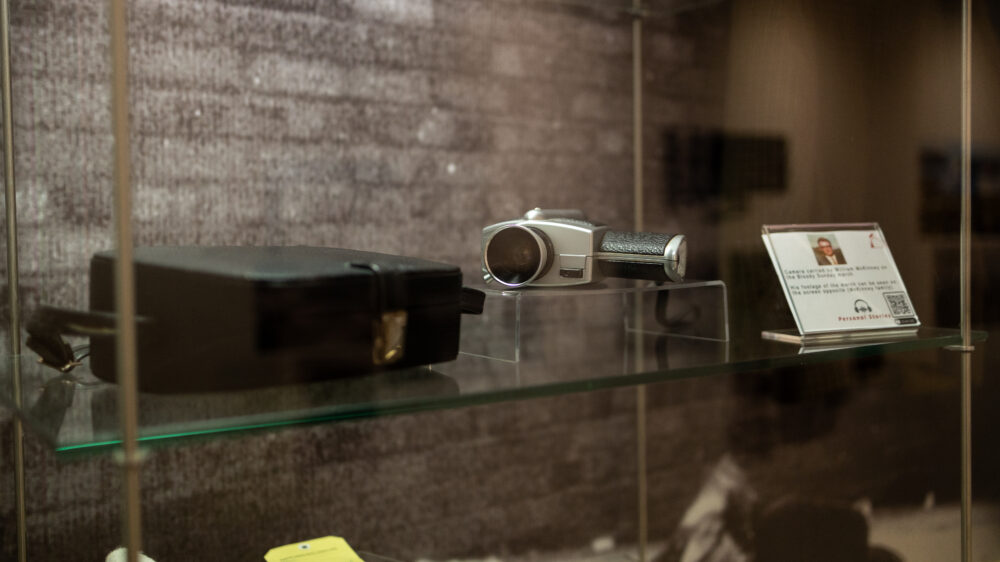
In 2007, the families opened the Museum of Free Derry, which displays memorabilia from the march and educates visitors about the events of Bloody Sunday and the people who were killed or injured. The museum is in the Bogside, next to Glenfada Park, the car parking lot where William McKinney and Wray were killed. Film footage of the civil rights march taken by William McKinney's movie camera has been made digital and plays on a loop at the museum. His camera is also on display.
Jean Hegarty, whose brother Kevin McElhinney was killed on Bloody Sunday, also works at the Museum of Free Derry. When I met Hegarty, we walked outside the museum, and she pointed to some brick row houses nearby. Each of the houses looks similar, but one stands out with its white door, and white trim around the bay window. A short brick fence surrounds the porch and a small grass area. This is the house her brother was crawling to for safety when he was shot by a British soldier, Hegarty told me.
On Bloody Sunday, Hegarty, who is now 76 years old, lived in Canada. She moved back to Londonderry in 1996 and devoted her efforts to educating people about Bloody Sunday. There is not enough evidence to prove which soldier killed her brother, she said.
Hegarty said she is happy someone will be held accountable for the deaths of some of the victims, but she wonders why some families may receive justice and others will not.
“I think it's something I can live with,” Hegarty said, although “I don't know that it's something I don't have a degree of resentment about. But the resentment I would definitely not think is with the McKinney family; the resentment would be with the British army and the security forces.”
Hegarty shows her support for the McKinney and Wray families by attending the court hearings as often as she can. “I don't know why I'm a bit obsessive because you're in the court for five minutes," she said, "but part of that is, I feel it's a bit of loyalty to Kevin.”
Protection for Soldier F
Another point of contention for the victims’ families is that the suspect’s identity continues to be kept confidential, due to an interim court order to protect him because he could be at risk of a targeted attack if he is identified.
At court hearings, Soldier F is concealed behind a screen and people are barred from revealing his identity or speaking his name. McKinney and the Wray family have fought against concealing Soldier F’s identity because they have seen him in person during the public inquiry, and many people already know his identity, McKinney said. They lost that battle, but others are pushing back by naming who they claim Soldier F to be as an act of resistance.
On July 13, 2021, Colum Eastwood, Member of Parliament of the United Kingdom, using his parliamentary privilege in the House of Commons, said, “Almost 50 years ago 14 unarmed civil rights marchers were murdered on the streets of Derry by the Parachute Regiment. Five of those victims were shot by David Cleary, otherwise known as Soldier F.”
In the weeks before Eastwood’s remarks, Londonderry residents showed solidarity with Eastwood on social media, and in signs posted around Londonderry that read “Soldier ‘F’ is Dave Cleary. No more anonymity.”

As the trial date nears, McKinney continues to struggle with balancing his mission and mental health. He jogs on a treadmill and listens to Phil Collins and Genesis to clear his mind of the memories he dredges up each day on tours. But he’s not yet sure how to mentally prepare for the potential of the worst outcome — a “not guilty” verdict after a lifetime of waiting.
“Bloody Sunday happened in 1972, and I was just 8 years old,” he said. “I’m now 61 and that's how long we've been waiting on a trial.”