
LONDONDERRY, Northern Ireland — Jesus, understandably, is the star of most Passion Plays. The story of Christ’s Passion, derived from the Latin word “passio,” meaning “suffer” — recounts the final days leading to Jesus’s crucifixion and death, based on accounts in the four Gospels of the Christian Bible. In the Northern Ireland town of Londonderry, however, Jesus gets second billing.
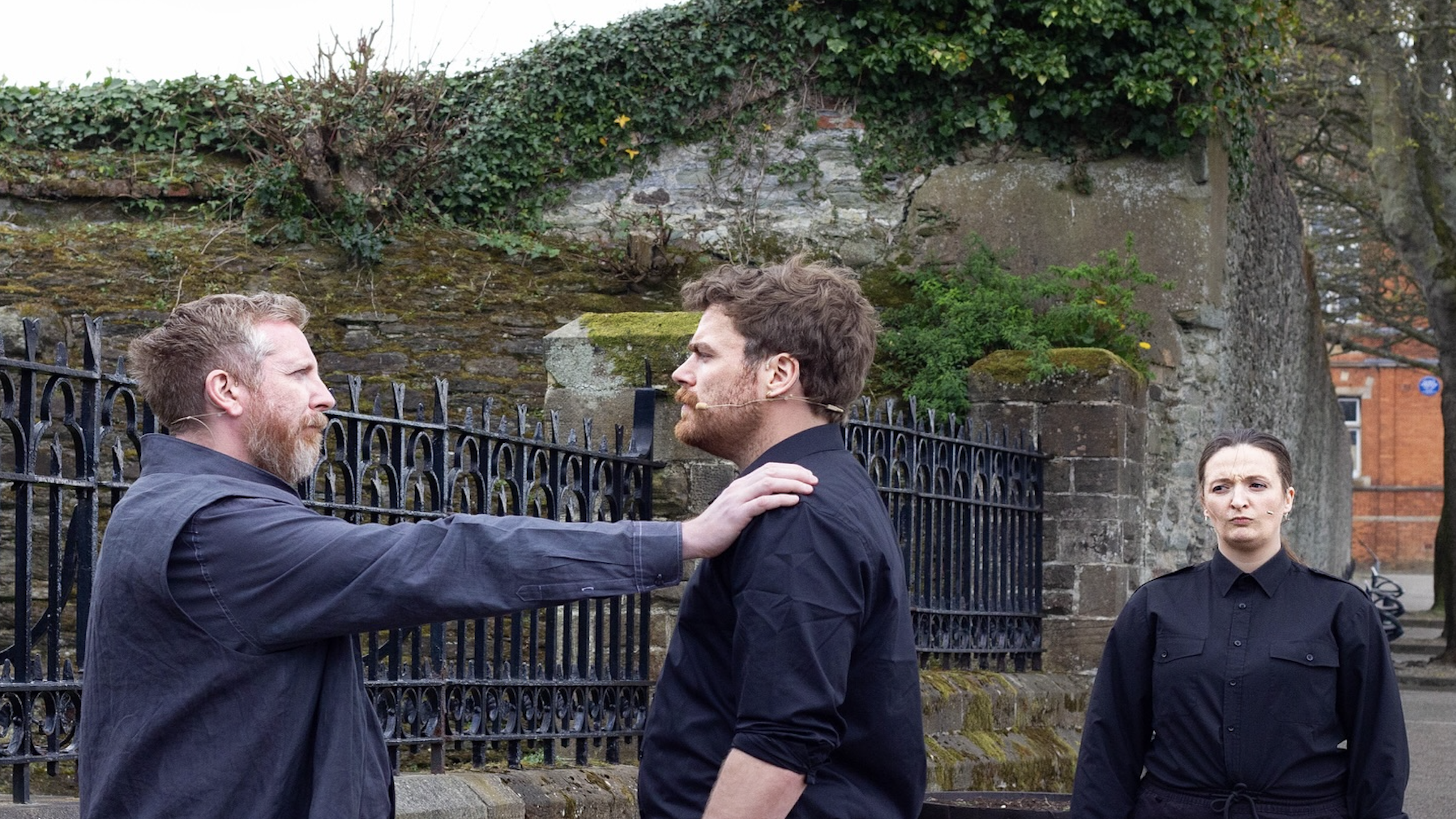
Londonderry’s “Walled City Passion,” a live, outdoor dramatization of the Passion Play set in modern times, takes some liberties with the Gospel stories. Last year, for example, Pontius Pilate’s wife, Claudia, and Jesus’ friend Mary Magdalene took the spotlight. This year’s lead character was Dave, one of four guards charged with delivering Jesus to his death. Dave wears a navy blue protective vest printed with “IST” (short for Internal Security Team) in white block letters, a black long-sleeved shirt and pants, and combat boots. He’s just doing his job as he joins his fellow officers in arresting a rabble-rouser. Then, he develops a conscience.
“We are delivering this man to be killed,” Dave says in the play. “And for what? Because we were told to.”
The production, now in its fourth year, takes place on the storied 400-year-old stone walls that surround the city center of Londonderry, also known as Derry. Jonathan Burgess, the playwright and director, is not interested in portraying Jesus as SuperMartyr, or transforming his crucifixion into a histrionic spectacle. He presents the Passion each year from the point of view of lesser-known figures in the hope that viewers, whether or not they are religious, will relate to the characters and find the story more relevant.
It is not, Burgess said, about the Catholic/Protestant divide that this city was once famous for, and characters like Jesus and Judas don’t represent real historical figures: “We wouldn’t draw those kinds of connections, because it depends on what it represents to the community. People make their own connection.” He has no special message about peace and coexistence; it is just about developing a better understanding of the central story of Christ’s resurrection.
For Christians of all denominations who do find religious meaning in the Passion, he said, “we’re trying to provoke you to be more actively engaged.”
Passion Plays, first performed in Latin during medieval times throughout Europe, then in vernacular languages, are still popular around the world. During Holy Week, from Palm Sunday to Easter Sunday, Christian churches of all denominations usually present a dramatized version of the Passion. Parishioners might read the Gospel passages during a service, or clergy might read from a script as they take on the roles of Jesus, his disciples and others, sometimes with congregants reading the parts of the crowd, who yell, “Crucify him.”
Some churches go to great lengths to reenact the story with costumes, music, props and special effects. The action reaches a climax when a bloodied, beaten Jesus is nailed (usually by ropes) to a cross. Although old productions of the Passion Play were notoriously antisemitic and depicted Jews as conniving Christ killers, most of those versions were purged of such bigotry after the Second Vatican Council of the mid-20th century. The “Walled City” version has none of those canards.
Burgess is known for his quiet but probing plays that re-create the real stories of working-class people during the Troubles — the period of religious and political strife in Northern Ireland from 1968 to 1998, when the majority Catholic/republican population, who wanted to join the Republic of Ireland, fought with the ruling Protestants/loyalists, who wanted Northern Ireland to remain a part of the U.K.
Although Burgess, 53, is proudly Protestant, and grew up during the Troubles, he is committed to peace and reconciliation with Catholics. Burgess said he and Archdeacon Robert Miller of the Church of Ireland, who have worked together on peace-building in Londonderry, came up with the idea for “Walled City Passion” five years ago when they noted that many Christians had distanced themselves from the Easter holiday. They worried that “people like to park Easter and look at it,” Burgess recalled during an interview at the Londonderry offices of the Church of Ireland. “They don’t want to actually engage with it. They want to observe it from far away and ‘over there,’ where it’s safe. We’re trying to make it a wee bit more dangerous.” People from all Christian faiths, as well as those who don’t consider themselves religious, attend the performances.
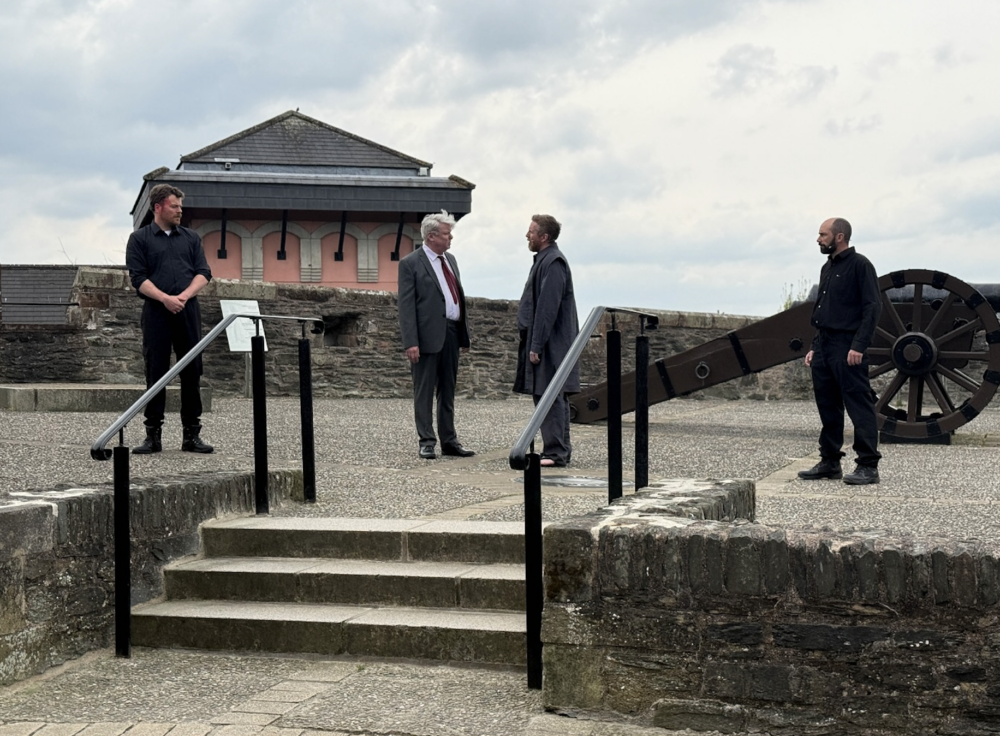
The “Walled City” of the title refers to the historical stone walls in Londonderry, built from 1613-1619 to protect English and Scottish settlers. All the action in “Walled City Passion” takes place on or within these walls, which form a 1-mile walkway around the city center and range from 12 to 35 feet high. The walls have never been breached, even during a 105-day siege in 1689, which is why one of Londonderry’s nicknames is “the Maiden City.” They were closed down and suffered damage during the Troubles, but reopened to the public in 1995. “The most significant thing we can do is bring people back onto them again, to a place that was once seen as confrontational,” Burgess said.
The changes Burgess makes to “Walled City Passion,” however, are not expressly about the Troubles, and well-known characters like Jesus and Judas don’t represent real, contemporary historical figures, he said: “We wouldn’t draw those kinds of connections, because it depends on what it represents to the community. People make their own connection.”
“Walled City Passion,” this year with performances in the days leading up to Easter, began at the Church of Ireland offices inside the walls, then moved to the gardens of St. Columb’s, an Anglican cathedral built in 1633. Scenes took place at 10 stops along the walls, including historical gates and artillery bastions with space for staging, ending outside the neo-Gothic Guildhall government building. Much of the movement occurred on the wide Grand Parade portion of the walls, which fans of “Derry Girls” might recognize from the finale of the Netflix sitcom, when Erin’s cousin Orla dances joyfully there with a group of young Irish dancers.
The show must go on in all types of weather, including rain, wind and snow. One of the actors, Susie Garvey-Williams, who last year played Mary Magdalene, said the weather sometimes intervenes in unexpected ways. She recalled how last year, Caiaphas, a high priest, was berating Jesus, and suddenly the heavens opened, and snow poured down. “Sometimes you have those moments you’d never have in a theater,” she added.
Audience members don headphones to hear the actors, who wear microphones. When the audience moves from one setting to another, they listen to a recorded narration that guides them. The walls are a popular community and tourist attraction, so residents and visitors, too, wander along as usual during the play.
This year the main cast comprised 13 professional actors, with extras from a local performing arts college.
The play starts out with Dave getting a call at home to report to Gethsemane, the garden where Jesus was arrested, to handle a routine civil disturbance. Dave “is cynical, brutal and tired, but … we also see his loving side” as he interacts with his fiancee, Burgess said. In the garden, a disciple stabs Dave, but Jesus heals him (in the biblical story, Jesus heals a servant whose ear is cut off). Once the “miracle” of healing happens, Dave’s perspective starts to change. As he and the other guards march their prisoner to his demise, Dave comes to see Jesus as a savior rather than a troublemaker.
Garvey-Williams played a guard in this year’s production. Unlike Dave, her character, as a new recruit, “is very much about doing what the sergeant says, and following orders,” Garvey-Williams said. “And my last line is, ‘We were only doing what we were told.’ I think that idea is very important. What orders are we all following today? We try and step away from our responsibility for the actions we choose sometimes as human beings.”
Burgess said he doesn’t have a particular goal for audiences other than wanting them “to think,” especially about preconceived notions. For example, he described a scene from the 2024 production about the woman who washes Jesus’ feet (with perfume or tears, depending on which Gospel account you read), and dries them with her hair. The woman is described in the Bible as a sinner. Burgess thus created a costume that suggested a stereotype of a modern-day sinner: The actress wore black fishnet stockings, combat boots and a revealing top.
As the actress strolled atop the walls, an audience member mistook her for a passerby, Burgess said. The audience member “was tut-tutting and rolling her eyes at the fact that this girl was out here walking.” Then, the actress took Jesus’ hand, took out a bottle of water out of her backpack, and washed and dried his feet. The idea, Burgess said, was to “get people to stop prejudging.”
Garvey-Williams said keeping an open mind also applies to attitudes about the guards. Playing an officer has helped her understand how dangerous the job is, and why law enforcement officials are so close-knit: because “it’s us against the world. We keep each other safe.”
In traditional Passion Plays, Jesus’ guards are villains, in a black-and-white scenario that ignores that they have fears and worries, too. In the gray world of “Walled City Passion,” everyone on the walls wants to remain safe.
Photo at top: In “Walled City Passion,” Andy Doherty (center) and Susie Garvey-Williams (right) play guards who deliver Jesus (Stephen Bradley, left) to his death on the cross. (Photo courtesy of “Walled City Passion”)