

A Discussion on Parenting in the Anglican Church
NEW YORK — For Pastor Jim Salladin, connecting with congregants goes beyond leading worship services in the West Village every Sunday morning; it extends from the pulpit to Zoom, where nearly 20 members of Emmanuel Anglican Church gathered virtually on a recent Tuesday evening. Salladin organized a curiously intimate conversation for teachers and parents to discuss how they should talk to children about God and the teachings from the Bible when they are old enough to ask: "What does this mean?"
Salladin said this is the big question that hangs over the experience of every person who has grown up in the church. “As believers in Jesus Christ, as Christians, we point back to the story of who Jesus is and what Jesus has done for us, and then what it means to repent and believe,” he said. “But you notice it doesn't say our ancestors were slaves in Egypt. It says we were. That there's a way in which we tell the Gospel story, not as something that happened long ago to someone else, but we tell it as our own story.”
The few members who have chosen to keep their camera on in the Zoom meeting lean into their computer screen to listen closely to Salladin’s words. They sit at a desk with a pen in hand or on a couch with their spouse, arms wrapped around one another. Emmanuel Anglican Church, a congregation part of the Anglican Church in North America, is a theologically conservative church with a special outreach to parents of young children. One woman, who occasionally holds her newborn within the frame of the camera, shares with the group that even though her baby is only 2 months old, she’s already grappling with how to explain the concept of sin to her child one day.
Salladin encourages parents to not hide the reality of their children’s sins, and their own, from them because Jesus has done everything necessary for their redemption. “Don't ever hide your own repentance,” he said. “Repent in front of them. They're going to see the wonderful bits of who you are. Let them also see you weeping at your own sin.”
When answering children’s questions about the scriptures, Salladin said, adults should help children understand this is the story that gives them an identity; an identity rooted in something that happened before they were born and is even bigger than the universe. “It's the story of a God who loves you and created you, and even in the midst of all the evil of this world, sought to redeem you, and has secured for you a hope that will never die,” he said.
The last 15 minutes of the hourlong conversation conclude with prayers. Salladin invites congregants to pray out loud, and one by one worshippers unmute themselves on Zoom to share their own prayers in this unconventional setting. They gently bow their heads; their hands frame their face; and their fingers press lightly against their forehead or eyes, which are closed to receive each blessing. Whether in person at church or together over Zoom, this position is universal.
Dear Lord,
Thank you so much that every opportunity that we have as parents when we fail, is also an opportunity to exalt you as the better Father. I pray that you would just meet us in those moments of anxiety that we have of, ‘Are we doing it right? Are we seeing the right thing?’ When we ourselves have doubts and questions that you would just fill in the gaps with the power of the Holy Spirit.
“The path of Christian parenting is that we, you and me, must be animated by the Gospel of who God is in Jesus. What God has done for us in Jesus, so that he becomes the love of our life,” said Salladin. “And then the teaching of the children grows out of that.”

Fashioning Wheat Stalks into Brigid’s Cross, An Imbolc Tradition
NEW YORK — On a chilly Saturday afternoon in February, a dozen people from all over New York City gathered in The Meadow, a creative arts studio under the Manhattan Bridge overpass in Brooklyn. The practitioners of Celtic spirituality sat around a wooden table littered with half-eaten cookies, teacups of wildflower tea and piles of long stalks of wheat.
They came together to celebrate the Irish holiday of Imbolc, based on the Celtic Wheel of the Year and the Druidic calendar. Julie Flynn, a woman known as the Keeper of The Meadow, provided each person at the table with a pile of damp wheat stalks, a couple inches of twine and a paper printout of a plaited pattern. For the men and women gathered at the studio, the creation of Saint Brigid’s cross connects them to an Irish tradition that’s been around for centuries.
Flynn soaked the stems in water for 30 minutes to soften them before the lesson and stood up at the front of the room to demonstrate the crisscross design. With one stem held vertically and the other horizontally, she folded the second stem over the first and turned the wheat 90 degrees counterclockwise. With each turn she added one more stem, over and over until a T-shaped cross with a diamond center began to form. As she weaved, she explained that the symbol of Ireland is usually fashioned out of rushes and hung above the front door of a home to ward off evil.
The sound of rustling wheat stocks filled the room as devotees began to build their emblems. A woman near the head of the table finished making her cross within minutes, and people at the table stopped to admire her handiwork. Eventually the other practitioners caught up and began tying the arms of their tokens with twine to hold their shape. Flynn then explained how Brigid’s cross is different in design from the Christian symbol because it is hung with the arms at an angle instead of parallel to one another.
Along with the lesson, Flynn played a video from Marisa Goudy, a local scholar of Irish mythology. “Imbolc is really associated with being the season of Brigid herself,” said Goudy. “It’s when the snowbells are beginning to emerge, and it feels as if spring is touching the island of Ireland again.”
Goudy appeared on Flynn’s computer screen, wearing a scarf around her neck patterned with Brigid’s cross. “You'll hear many people refer to Brigid as goddess and saint in one breath because they really are indistinguishable in the modern imagination,” said Goudy. She sees Brigid as more of a goddess, one associated with witchcrafts, healing and poetry.
Imbolc honors a long arc of history in which Brigid was embraced by both pagan and Christian traditions. Some historians believe the ancient Celtic goddess was syncretized with Saint Brigid of the Christian faith. It isn’t known for certain whether Brigid and Saint Brigid are one in the same, but the overlap of Druid and Christian belief continues to this day.

A School Hall Becomes a Sanctuary: Evangelical Worshippers Find Rhythm and Reverence on the Upper West Side
NEW YORK — A young man in a green beanie has both arms outstretched to the sky, palms open to receive, the top of his iPhone poking out from the back pocket of his jeans. He rocks back and forth on Nike runners, swaying to the steady strum of acoustic guitar that floats around the school hall. A few seats in front of him, a woman chews her gum to the beat of the drum box, tensing and relaxing her jaw in time. Da dum, da dum, da dum.
“What we’re doing is kinda just a free flow, you know? I think that word sometimes helps me process what it is that happens when we worship. We’re just responding.” The voice comes from one of the five musicians facing the Evangelical congregation at Hope Church on the Upper West Side at 163 W. 97th St. It’s the kind of voice that sounds as if it’s carved from mahogany, deep yet warm — a voice that could soothe a crying child. Rock it back to sleep. Tame a storm. Put out a fire.
The five performers stand separately but they breathe as one.
Oh, everything changed, it’s getting harder to recognise
The person I was, before I encountered Christ
I don’t walk like I used to. I don’t talk like I used to
I’ve been washed from the inside
The drums run underneath it all, the cool current of a stream; violin notes fall long and slow, like winged seeds of a maple; the alto and soprano voices are crisp air and sun on a winter’s day; piano arpeggios skate over the top.
From the first word, the energy shifts among the 50 worshippers. A sea of duffle coats and blue jeans begins to swing, like trees in an orchard blown by the same wind. One woman in Ugg boots and a rainbow sweater closes her eyes. A hairline crease appears between neat black brows. To her right, another worshipper clasps her hands tightly and shakes them to the beat, gold hoop earrings tilting with each pulse. A man in a plaid shirt with silver hairs peeking through his dark mop sings out of tune. Loudly. But it doesn’t matter — no one seems to notice, and if they do, no one judges.
People are someplace else now, some further away than others. The drummer cracks his knuckles one by one while the room floats on the waves of the music. The song rises like a tide. The drums pick up their pace, each thud like the step of a sprinter on the final leg of a relay. The soprano singer clutches her small frame through a white jumper. Her right hand rests on her diaphragm but her left reaches up toward the sky, fingers twinkling like stars. As she belts out the words, her tortoiseshell glasses reflect the lights of the hall.
Hallelujah, Hallelujah
I know it was the blood
Could have only been the blood
Could have only been the blood
The music transforms the school hall, with its glaring emergency exit signs, fire alarms, random bits of red duct tape and faded blue curtains, into a place of magic. It’s so cold that some people still have their gloves on, but the invisible vibrations warm the room.
The guitarist leans into his microphone, “Church, can we just sing that again?”
He doesn’t need an answer. The congregation belts out the refrain, over and over. They repeat the chorus five times, until the musicians bring them back down, gently and softly as a whisper.
Edited by Haley Duffy

An Imbolc Ritual: Quiet Reflection and Flowers of Ireland
NEW YORK — A hush settles over the room at The Meadow, the expressive arts space in the northernmost Brooklyn neighborhood of Dumbo. Men and women sit cross-legged on the floor, and the studio is quiet except for the sound of breaths. Gaelic embroidery of green fields and birch trees are strung from a branch on one wall. A colorful tapestry depicts the night sky speckled with stars and anchored by a crescent moon.
Today, a dozen people are taking part in the annual ritual of Imbolc. The tradition is dedicated to the deity and Druid high priestess Brigid, both a Celtic saint and a pagan goddess.
Saint Brigid is Ireland’s only female patron saint; she has long been admired in the Christian faith for her charitable work founding convents and monasteries on the island. In the Druidic faith, Brigid is known as the goddess of fire, healing and poetry. Today, she is recognized in both neopagan faiths and in the teachings of Christ for her Druid and Christian roots.
The celebration of Imbolc marks the change of the seasons and the start of spring. The Meadow’s seasonal circles are based on the Celtic Wheel of the Year, which is closely associated with the Druid calendar. The young and old sit in a circle on the floor of the dimly lit room around a flickering candle. Julie Flynn, the creative director of the space, passes around a tiny glass vial filled to the brim with a mixture of oil and rose petals.
“Imbolc marks the halfway point between winter solstice and spring equinox,” says Flynn. “As we honor Brigid, goddess of healing and fertility, I want you to picture your ancestors standing behind you, back and back, seven generations all supporting you. Now breathe in the oil and the flowers of Ireland, and imagine your descendants in front of you, generations on generations. Brigid is with you as we emerge into spring.”
The medicine bottle is small enough to hold in one hand and, although at first glance it may seem as though it’s a small part of today’s two-hour celebration, the participants hold the bottle with such tender care that the object’s significance is felt in the room. Brimming with Imbolc oil and crafted from wild roses grown in the Irish countryside, the vial is a central part of today’s ceremony.
The oil serves as a reminder to ground deeply and root into the present moment, providing an opportunity to plant wishes and desires for the future. Flynn continues to speak softly, leading the group in a meditation as members gently shut their eyes, some clasping their hands in their laps and some holding their hands over their hearts. She asks them to imagine they are closely aligned with nature, allowing the scent to transport them to a spring day.
One woman murmurs in understanding as others breathe deeply smelling the oil on their wrists. Flynn describes this time of year as a gentle season, asking the members to honor the days as they grow longer and look ahead to warmer times, as Brigid keeps the light alive with her flames. “Remember the trees with the strongest roots are the ones that will survive the storm,” says Flynn. “And the trees that aren’t deeply rooted are the most likely to be swept away.”
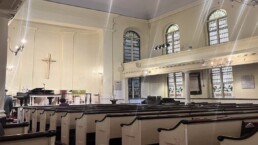
‘None of us is getting it quite right all the time’: Methodists Confess in Fidi
NEW YORK — Midway through the Sunday morning service at John Street United Methodist Church in Lower Manhattan, Pastor Stephanie Bennett asked members of the church to partake in a prayer of confession.
She noted it was a Communion Sunday, and the confession prayer is a moment to recognize that “none of us is getting it quite right all the time, and probably there are days where we’re real, real, real far from quite right. Knowing that we’re not quite who we want and intend to be, but trusting that we are, in faith, getting there.”
The church, at 44 John St., was founded in 1766 and is the oldest Methodist church in North America. In the basement of the church is a museum that includes historical artifacts, such as a clock that was a gift from Methodist movement founder John Wesley.
There were only 15 worshippers at the Sunday service. They ranged in age and gender, and most came alone. Familiarity among them was clear, though, as the small group acknowledged each other through smiles and salutations before they situated themselves in different pews. The large Gregorian-style hall, lit up by a few sconces and one chandelier, was painted a cream hue and modestly decorated beside several colorful stained-glass windows.
The pastor, 55 years old, was clad in a black sweater, pants and boots, and a white clerical collar. Her color scheme matched the grand piano used to accompany the four hymns sang that day. She began the confession prayer with these words:
Holy God, / Open our eyes to the presence of your Spirit / upon us, within us, among us.
Worshippers stayed perched on the red cushions of the pews as they responded to the prayer. Though most were sat scattered apart, their voices came out as one under the soft light that came in through the windows.
For our apathy in the presence of oppression / Forgive us.
Rather than go to a priest like other Christian denominations, Methodists don’t need an intermediary for forgiveness, nor do they see confession as a sacrament. Instead, they speak the prayer of confession as a corporate act, pray right to God, and expect to be forgiven.
If we have contributed to the brokenheartedness of anyone / Forgive us.
The prayer is spoken in preparation to come to the Lord’s Table, not only a Methodist table, Bennett said, to receive Communion. It is not in Methodist doctrine to believe in transubstantiation, a literal change in substance of the bread and wine to the actual body and blood of Christ. The feast prepared for them is instead a mystery, Bennett said.
For our participation in systems that do great harm / Forgive us.
Bennett’s choice in the prayer of confession wasn’t accidental. The purpose of the prayer isn’t just to receive forgiveness from God but also to acknowledge sins. Bennett, who sat at a table in the museum and spoke to churchgoers, drank a coffee from Starbucks and wore clothes that she said someone was probably paid 6 cents an hour to make. She acknowledged she’s benefited from systems that do great harm. The purpose is to “fully examine ourselves,” she said.
When our mouths remain too tightly closed, / Loosen our lips with songs of praise and hope. / Hear our prayer, O God, and forgive our sins. / Hold us in your mercy, now and forever. / Amen.
After a moment of silence, Bennett asked the congregation to speak aloud God’s forgiveness of them. Only the creaks and murmurs privy to the first Methodist church on the continent were heard in the quiet. It sounded like a sigh of relief, breathed in by the inhabitants inside and exhaled out by the chapel into the streets of New York.