
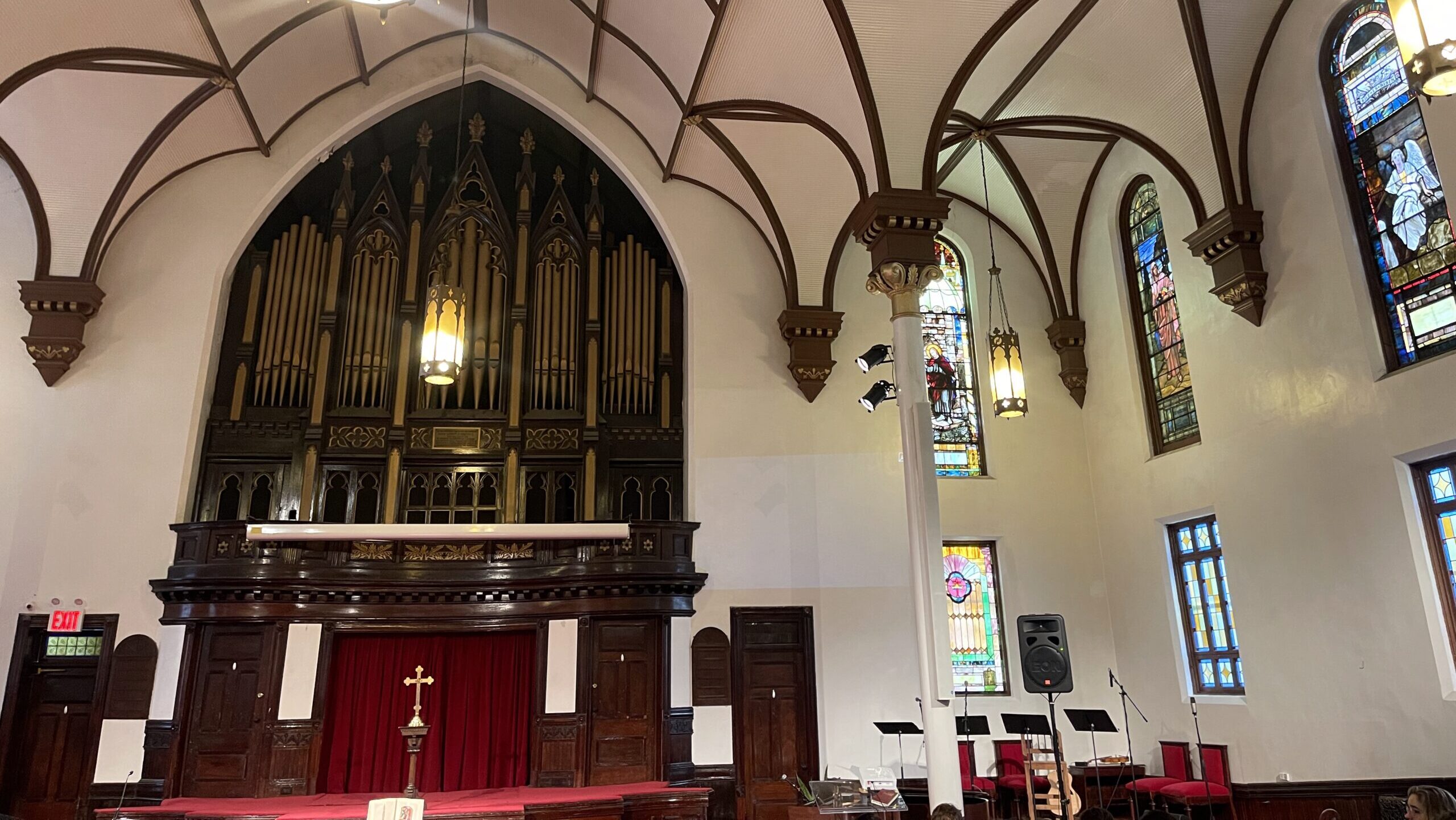
NEW YORK — For Pastor Jim Salladin, connecting with congregants goes beyond leading worship services in the West Village every Sunday morning; it extends from the pulpit to Zoom, where nearly 20 members of Emmanuel Anglican Church gathered virtually on a recent Tuesday evening. Salladin organized a curiously intimate conversation for teachers and parents to discuss how they should talk to children about God and the teachings from the Bible when they are old enough to ask: “What does this mean?”
Salladin said this is the big question that hangs over the experience of every person who has grown up in the church. “As believers in Jesus Christ, as Christians, we point back to the story of who Jesus is and what Jesus has done for us, and then what it means to repent and believe,” he said. “But you notice it doesn’t say our ancestors were slaves in Egypt. It says we were. That there’s a way in which we tell the Gospel story, not as something that happened long ago to someone else, but we tell it as our own story.”
The few members who have chosen to keep their camera on in the Zoom meeting lean into their computer screen to listen closely to Salladin’s words. They sit at a desk with a pen in hand or on a couch with their spouse, arms wrapped around one another. Emmanuel Anglican Church, a congregation part of the Anglican Church in North America, is a theologically conservative church with a special outreach to parents of young children. One woman, who occasionally holds her newborn within the frame of the camera, shares with the group that even though her baby is only 2 months old, she’s already grappling with how to explain the concept of sin to her child one day.
Salladin encourages parents to not hide the reality of their children’s sins, and their own, from them because Jesus has done everything necessary for their redemption. “Don’t ever hide your own repentance,” he said. “Repent in front of them. They’re going to see the wonderful bits of who you are. Let them also see you weeping at your own sin.”
When answering children’s questions about the scriptures, Salladin said, adults should help children understand this is the story that gives them an identity; an identity rooted in something that happened before they were born and is even bigger than the universe. “It’s the story of a God who loves you and created you, and even in the midst of all the evil of this world, sought to redeem you, and has secured for you a hope that will never die,” he said.
The last 15 minutes of the hourlong conversation conclude with prayers. Salladin invites congregants to pray out loud, and one by one worshippers unmute themselves on Zoom to share their own prayers in this unconventional setting. They gently bow their heads; their hands frame their face; and their fingers press lightly against their forehead or eyes, which are closed to receive each blessing. Whether in person at church or together over Zoom, this position is universal.
Dear Lord,
Thank you so much that every opportunity that we have as parents when we fail, is also an opportunity to exalt you as the better Father. I pray that you would just meet us in those moments of anxiety that we have of, ‘Are we doing it right? Are we seeing the right thing?’ When we ourselves have doubts and questions that you would just fill in the gaps with the power of the Holy Spirit.
“The path of Christian parenting is that we, you and me, must be animated by the Gospel of who God is in Jesus. What God has done for us in Jesus, so that he becomes the love of our life,” said Salladin. “And then the teaching of the children grows out of that.”