
Ireland Long Ago Closed Mother-and-Baby Homes, but Their Painful Legacy Remains
LONDONDERRY, Northern Ireland — In May 2024, Billy Scampton from Londonderry and Shannon Ritchie-Leet from Ontario, Canada, walked to the edge of River Strule in Omagh, Northern Ireland. Together, they scattered the ashes of their mother into the water and watched as the river carried them away.
The two siblings may have been sharing an intensely moving moment — but they were recently strangers. In fact, they had just met several months prior through social media.
A year earlier, Shannon had posted on Facebook that she was planning a trip to Ireland and wanted to know more about her ancestry and the family of her mother, Moya Beckett, who immigrated to Canada from Ireland as a young woman and died of dementia in 2019. Shortly before Moya passed, she told Shannon that when she was a teenager, she was forced to give up a little boy she had given birth to in Northern Ireland.
That baby boy was Billy, who is now 62 years old.
Billy, meanwhile, who was adopted as an infant, had been searching for his birth mom for over a decade, after both his adoptive parents passed away. But he had no leads until he came across Shannon’s public post, which included the one detail he knew about his mother — her name.
“[That post] ticked all the bells and whistles,” he said. “Truth be told, it scared the friggin’ life out of me.” Billy reached out to Shannon.
“Shannon, I am your mommy’s little boy,” he wrote to her.
Billy had spent the first few days of his life at Marianvale, one of many mother and baby homes in a network of institutions across the country, located in Newry, Northern Ireland. These institutions — as well as Magdalene laundries, or asylums — were run by both Catholic and Protestant clergy in Northern Ireland and the Republic to rehabilitate “fallen women,” mostly unwed mothers to be.
Moya’s mother, a Catholic, secured her daughter a place at Marianvale to bring the baby to term and give him up for adoption. The institution was run by the Good Shepherd Sisters, a Roman Catholic order of nuns.
Billy is one of tens of thousands of Irish people born in these homes in the 20th century. Like many others, he is trying to honor the woman who gave birth to him and reckon with this dark period in Irish history.
Marianvale, which saw an estimated 1,399 women from 1955 to 1984, was a place of pain and humiliation, Billy said.
“I think the whole experience dogged her all her life,” Billy said. “She was forced to give up her firstborn and was sent away, basically plucked out like a weed out of a driveway.”
“It had a severe impact of suppressive trauma,” he added.
These institutions are now widely known to have been abusive, including through unpaid work and forced adoptions. Testimonies collected from survivors noted that staff were cruel and made the women feel ashamed of their pregnancies, and birth preparation was deficient, according to a report by researchers at Ulster University and Queen’s University in Belfast.
Thousands of babies died across the country at these homes. In 2017, a mass grave with the remains of 736 babies and children was discovered at a former mother and baby home in the Republic of Ireland.
Though Billy never visited Marianvale, which is about 80 miles — or two hours — from his home in Londonderry, a friend gifted him tiles from the floor of the institution.
Billy, a Reiki master, immediately tuned into the energy he picked up from the tiles.
“The first thing I sensed off them was pain and anguish,” he said. “They were a place of sorrow.”
The tiles are a remembrance of a place now gone. Marianvale was demolished in 2021, a decision Billy said he mostly supported, with a stipulation.
Preserving the site, he said, would have been macabre. “But there should be some sort of a memorial on site there.”
How the sites are handled is a point of contention for some survivors. Though many of these institutions have been demolished, a number of survivors in the Republic of Ireland and Northern Ireland have pushed for preserving the remaining sites. In January, women who suffered institutional abuse at Dublin’s Sean MacDermott Street laundry, the last-standing Magdalene laundry in the Republic of Ireland, protested plans to develop the site.
The building has been vacant since the institution closed in the 1990s, and the Office of Public Works had planned to renovate it into a memorial space and research center. Survivors, however, felt they weren’t properly consulted and see the development as more of a “vanity project,” according to The Irish Times.
The same is true in Northern Ireland, said Mairéad Nic Bhloscaidh, who is leading a digital exhibition on Marianvale through Sole Purpose Productions, a social-justice-aimed theater group in Londonderry. “The place seems to have a very strong pull for [survivors],” she said.


Moya Beckett lived at Marianvale from June to September 1962. Billy was born in late August. At just a few days old, he was taken to Nazareth House, a baby home in Fahan in the Republic of Ireland, to be put up for adoption.
His mother left Marianvale the day after him, and within a year, her family sent her to Canada, where her sister lived. She never came back. And Billy never knew what happened after that.
That was, until he met Shannon, who was able to fill in some of the gaps about their mother’s life in Canada. She married there and later gave birth to two more children, a son named David, now 60, and Shannon, now 51.
After the two half-siblings connected on social media, Shannon took the trip to her ancestral homeland and visited Billy and his wife, Moira. They scattered their mother's ashes — and three roses, one for each sibling — five years to the day she told Shannon that she’d had a son in Ireland.
Since that trip, about a year ago, the two have continued to text and call one another, including on holidays. They have fallen into a natural sibling rhythm — bouncing thoughts off of one another and noticing their similar feet and left-handedness. Billy plans to visit Canada this year.
“It’s just the most profound experience of my life,” he said. “She’s the most incredibly smart girl I’ve met.”
Shannon hoped to learn more about her Irish ancestors before she visited Ireland a year ago and instead found a brother. The running joke, Billy said, is that she came looking for the dead and found the living.

The reunion was also bittersweet for Billy. “It was quite sad,” he said. “On one side, I was relating to the death of my birth mother, and on the other side, I [learned] I had a sister.”
He’s had to wrestle with the generational trauma often experienced by adopted children. “When they’re being carried by their mother, all the pain, everything that the birth mother has been subjected to, all the fear and whatnot, that’s also transmitted into the baby they’re carrying through the placenta. They absorb that there as well, too,” he said.
The ultimate betrayal, he said, is that the bond between the birth mother and the baby is severed irrevocably when the child is taken from them.
Although he was only a newborn and can’t recall how he felt in that moment, the trauma of being separated from the body he was attached to for nine months and who had nurtured him is a pain that he carries as an adult. It's like a hand cut off, he said. “That is something I’m working my way through.”
Billy was adopted by Ben and Vera Scampton of Londonderry at the end of 1962. “I carry my birth mother’s DNA, but it was Ben and Vera who are the people who raised me and made me into the person I am today,” he said.
Billy still wears his adoptive status as a badge of honor, he said, and it instilled in him a strong sense of right and wrong.
“Probably from what happened to [my] mother,” he said, “I don’t do injustice.” Though he doesn’t have children, Billy is also involved in student life at Ulster University as a soccer coach and mental health well-being first responder.
Conversations around Magdalene laundries and mother and baby homes are long overdue, said Dr. Livi Dee, an oral historian who is a testimony facilitator for the Truth Recovery Independent Panel, which is investigating how these institutions operated. Their work is part of a public inquiry and redress scheme for survivors in Northern Ireland.
In 2021, after the Commission of Investigation into Mother and Baby Homes submitted a final report to the government a few months prior, the Taoiseach (Irish prime minister) Micheál Martin issued an apology on behalf of the state for the “profound and generational wrong” that resulted in high infant mortality in these institutions.
The executive office called for an independent investigation, and since April 2023, the panel has worked to gather evidence and collect testimonies of survivors. The deadline for people to register to give testimony is May 1.
By participating, survivors are not just seeking compensation, noted Dee. “It's a recognition of what they went through.”
Billy, who gave testimony to the panel, is also personally seeking that public acknowledgment and remains angry at the religious orders that allowed these facilities to operate. He demanded that legislation be passed to ensure all remaining records are preserved and noted that adoptive children have been denied knowledge of their familial medical history — what he calls their ground zero. He didn’t even learn his mother’s name until he requested his baptismal records prior to his marriage.
“The religious orders can say, ‘We’re heartily sorry for this. This shouldn’t have happened,’" he said. “But that’s all from the teeth out. They’ve made a dangerous thing seem harmless.”
He tries to find the silver lining — noting he is blessed by having two mothers instead of one. But still he’s committed to maintaining the memory of Moya.
“It is important that the story is told,” he said. “There’s not a day that [goes] past that I don’t think about her.”
‘None of us is getting it quite right all the time’: Methodists Confess in Fidi
NEW YORK — Midway through the Sunday morning service at John Street United Methodist Church in Lower Manhattan, Pastor Stephanie Bennett asked members of the church to partake in a prayer of confession.
She noted it was a Communion Sunday, and the confession prayer is a moment to recognize that “none of us is getting it quite right all the time, and probably there are days where we’re real, real, real far from quite right. Knowing that we’re not quite who we want and intend to be, but trusting that we are, in faith, getting there.”
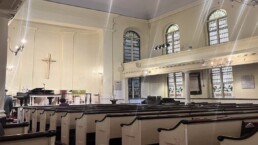
The church, at 44 John St., was founded in 1766 and is the oldest Methodist church in North America. In the basement of the church is a museum that includes historical artifacts, such as a clock that was a gift from Methodist movement founder John Wesley.
There were only 15 worshippers at the Sunday service. They ranged in age and gender, and most came alone. Familiarity among them was clear, though, as the small group acknowledged each other through smiles and salutations before they situated themselves in different pews. The large Gregorian-style hall, lit up by a few sconces and one chandelier, was painted a cream hue and modestly decorated beside several colorful stained-glass windows.
The pastor, 55 years old, was clad in a black sweater, pants and boots, and a white clerical collar. Her color scheme matched the grand piano used to accompany the four hymns sang that day. She began the confession prayer with these words:
Holy God, / Open our eyes to the presence of your Spirit / upon us, within us, among us.
Worshippers stayed perched on the red cushions of the pews as they responded to the prayer. Though most were sat scattered apart, their voices came out as one under the soft light that came in through the windows.
For our apathy in the presence of oppression / Forgive us.
Rather than go to a priest like other Christian denominations, Methodists don’t need an intermediary for forgiveness, nor do they see confession as a sacrament. Instead, they speak the prayer of confession as a corporate act, pray right to God, and expect to be forgiven.
If we have contributed to the brokenheartedness of anyone / Forgive us.
The prayer is spoken in preparation to come to the Lord’s Table, not only a Methodist table, Bennett said, to receive Communion. It is not in Methodist doctrine to believe in transubstantiation, a literal change in substance of the bread and wine to the actual body and blood of Christ. The feast prepared for them is instead a mystery, Bennett said.
For our participation in systems that do great harm / Forgive us.
Bennett’s choice in the prayer of confession wasn’t accidental. The purpose of the prayer isn’t just to receive forgiveness from God but also to acknowledge sins. Bennett, who sat at a table in the museum and spoke to churchgoers, drank a coffee from Starbucks and wore clothes that she said someone was probably paid 6 cents an hour to make. She acknowledged she’s benefited from systems that do great harm. The purpose is to “fully examine ourselves,” she said.
When our mouths remain too tightly closed, / Loosen our lips with songs of praise and hope. / Hear our prayer, O God, and forgive our sins. / Hold us in your mercy, now and forever. / Amen.
After a moment of silence, Bennett asked the congregation to speak aloud God’s forgiveness of them. Only the creaks and murmurs privy to the first Methodist church on the continent were heard in the quiet. It sounded like a sigh of relief, breathed in by the inhabitants inside and exhaled out by the chapel into the streets of New York.