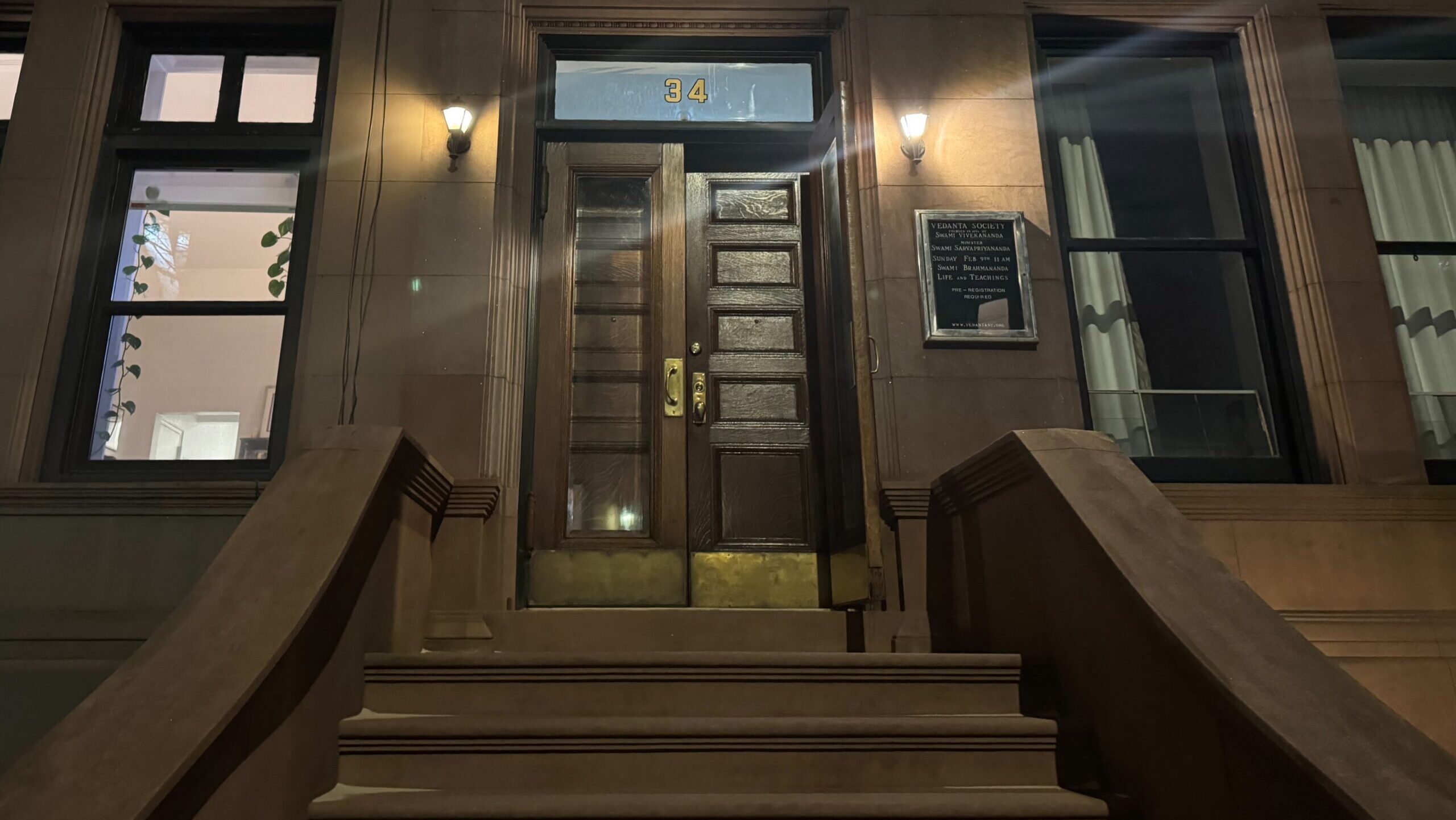
NEW YORK — In a brownstone on West 71st Street, just off of Central Park, inside the Vedanta Society of New York’s prayer and lecture space, a livestream is set up. Swami Sarvapriyananda, the spiritual leader of the society, is about to give his weekly Sunday lecture.
The swami takes a seat at the front of the room in front of the camera. He wears light orange garments associated with a Hindu monk like himself. Sarvapriyananda begins singing “Hymn to Sri Ramakrishna” by Swami Vivekananda , the society’s founder. Once the hymn is over, the swami bows his head and presses his hands together in prayer for a brief moment. Then, he begins to speak.
“Since the strength resulting from the knowledge of the self is independent of any means of acquisition, that strength alone is able to conquer death,” Sarvapriyananda says in Sanskrit, then English. This is the mantra the lecture is focused on today. It comes from the Kena Upanishad, a Vedic text used to guide those of the Hindu faith.
“What does this mean?” he asks, and pauses for a moment before continuing. “When Brahman is realized effortlessly, choiceless-ly, it shines.” The swami speaks candidly, his passion for the text evident from the excited expression on his face and the way he waves his hands around as he speaks. In the Hindu faith, Brahman is the “ultimate reality” or the “cosmic principle of existence” as described by philosopher Haridas Chaudhuri in his essay “The Concept of Brahman in Hindu Philosophy.” In the context of Sarvapriyananda’s words, Brahman describes the divine consciousness that all Hindus strive for.
All humans are immortal, he explains, but to achieve that immortality, one must fully realize their existence. The term the swami uses for this is “matam,” or true realization. Sarvapriyananda breaks down every section of the mantra using Hindu terms, but explains each term in English as well. It is a comprehensive spiritual education for devoted members of the society, but also teaches the fundamentals in a clear and concise way for those who may be earlier on in their spiritual journey.
The space has very little decoration throughout, and the walls are a plain gray. The only embellished part of the room is a shrine at the front next to Sarvapriyananda that displays photos of the Vedanta Society’s “Holy trio,” as they are called on the society’s website: Sri Ramakrishna, the saint; Vivekananda, the founder of the Society in New York; and Sri Sarada Devi, the Holy Mother. Lit candles and flowers are placed around the three photos, pulling one’s eye to them in the otherwise blank space. The only other piece of decoration in the room is a wall sticker with the society’s slogan: “Truth is one, sages call it variously.”
Vedanta is a branch of Hinduism that focuses on the Vedas, a series of holy Sanskrit texts that provide guidance to worshippers. Vedanta is described by the society as a method of realizing a goal of enlightenment and immortality that all religions share. They accept different religions as different paths of achieving this goal.
When Sarvapriyananda finishes, the lecture becomes a conversation. Each person listening is allowed to ask questions related to the knowledge learned today, or about another part of their spiritual journey. The last question is, “What do I have to gain or lose by being enlightened or not enlightened?” The swami smiles knowingly, like he has a secret, then shares that secret with the group: “Only the enlightened one knows.” He bows his head in blessing, and dismisses the congregation.